We sometimes hear of things that can travel faster than light. Something called 'the speed of thought' is occasionally proffered. This is an exceptio… - Carl Sagan
""
We sometimes hear of things that can travel faster than light. Something called 'the speed of thought' is occasionally proffered. This is an exceptionally silly notion especially since the speed of impulses through the neutrons in our brain is about the same as the speed of a donkey cart.
Carl Edward Sagan (9 November 1934 – 20 December 1996) was an American astronomer, planetary scientist, cosmologist, astrophysicist, astrobiologist, author, and science communicator. His best known scientific contribution is research on extraterrestrial life, including experimental demonstration of the production of amino acids from basic chemicals by radiation. Sagan assembled the first physical messages sent into space, the Pioneer plaque and the Voyager Golden Record, universal messages that could potentially be understood by any extraterrestrial intelligence that might find them. Sagan argued the hypothesis, accepted since, that the high surface temperatures of Venus can be attributed to, and calculated using, the greenhouse effect. He testified to the US Congress in 1985 that the greenhouse effect will change the earth's climate system.
Biography information from
Wikiquote·
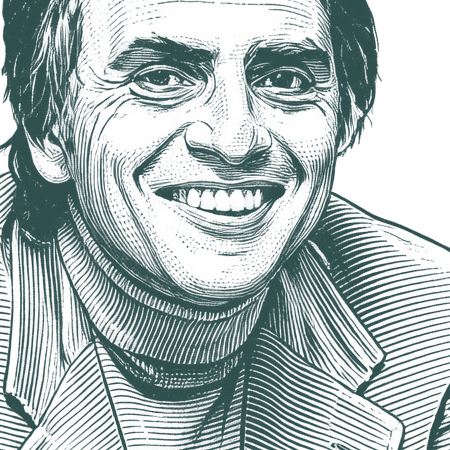
Portrait adapted from
Wikimedia Commons, NASA/JPL (Public domain / CC0)
Also Known As
Native Name:
Carl Edward Sagan
Alternative Names:
Sagan
•
Carl E. Sagan
•
Carl E Sagan
•
C. E. Sagan
•
C.E. Sagan
•
C E Sagan
•
C. Sagan
•
C Sagan
•
Sagan C
•
Sagan C.
•
Sagan C. E.
•
Sagan CE
The scientific way of thinking is at once imaginative and disciplined. This is central to its success. Science invites us to let the facts in, even when they don’t conform to our preconceptions. It counsels us to carry alternative hypotheses in our heads and see which best fit the facts. It urges on us a delicate balance between no-holds-barred openness to new ideas, however heretical, and the most rigorous skeptical scrutiny of everything — new ideas and established wisdom.
Може би някой ще изтълкува това мое твърдение като твърде широко, но аз смятам, че правим наука всеки път когато критикуваме самите себе си и проверяваме идеите си спрямо околния свят. Обратното - когато сме самодоволни и безкритични към себе си, когато не правим разлика между очаквания и факти, тогава рискуваме да се плъзнем към псевдонаука и суеверие.
Don’t you ever feel . . . lost in your universe? How do you know what to do, how to behave, if there’s no God? Just obey the law or get arrested?” “You’re not worried about being lost, Palmer. You’re worried about not being central, not the reason the universe was created.