Mahomet himself, after all that can be said about him, was not a sensual man. We shall err widely if we consider this man as a common voluptuary, int… - Thomas Carlyle
""
Mahomet himself, after all that can be said about him, was not a sensual man. We shall err widely if we consider this man as a common voluptuary, intent mainly on base enjoyments, — nay on enjoyments of any kind. His household was of the frugalest; his common diet barley-bread and water: sometimes for months there was not a fire once lighted on his hearth. They record with just pride that he would mend his own shoes, patch his own cloak. A poor, hard-toiling, ill-provided man; careless of what vulgar men toil for.
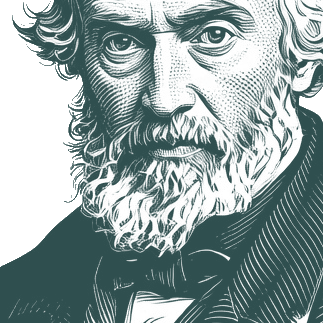
Thomas Carlyle (December 4 1795 – February 5 1881) was a Scottish essayist, historian and philosopher of great prominence during the Victorian era. His wife was Jane Welsh Carlyle.
Biography information from
Wikiquote·
Portrait adapted from
Wikimedia Commons, Sir John Everett Millais, 1st Bt (died 1896) (Public domain / CC0)
Portrait from Wikimedia Commons. Credit: Sir John Everett Millais, 1st Bt (died 1896). Used under Public domain / CC0. Processed and styled by Quotewise.
Enhance Your Quote Experience
Enjoy ad-free browsing, unlimited collections, and advanced search features with Premium.
Every pitifulest whipster that walks within a skin has had his head filled with the notion that he is, shall be, or by all human and divine laws ought to be, 'happy.' His wishes, the pitifulest whipster's, are to be fulfilled for him; his days, the pitifulest whipster's, are to flow on in an ever-gentle current of enjoyment, impossible even for the gods. The prophets preach to us, Thou shalt be happy; thou shalt love pleasant things, and find them. The people clamor, Why have we not found pleasant things? ...God's Laws are become a Greatest Happiness Principle. There is no religion; there is no God; man has lost his soul.
He who first shortened the labor of copyists by device of movable types was disbanding hired armies, and cashiering most kings and senates, and creating a whole new democratic world: he had invented the art of printing.
Money is miraculous. What miraculous facilities has it yielded, will it yield us; but also what never-imagined confusions, obscurations has it brought in; down almost to total extinction of the moral-sense in large masses of mankind!