Kita tidak mempertanyakan apa guna burung berkicau, sebab kicauan adalah kenikmatan mereka sejak mereka diciptakan untuk berkicau. Kita pun semestiny… - Carl Sagan
""
Kita tidak mempertanyakan apa guna burung berkicau, sebab kicauan adalah kenikmatan mereka sejak mereka diciptakan untuk berkicau. Kita pun semestinya tidak mempertanyakan mengapa manusia bersusah payah menyingkap rahasia langit... Keanekaragaman fenomena alam sungguh luar biasa, harta karun yang tersembunyi di langit bergitu banyak dan tertata dengan sangat baik sehingga akal manusia tidak akan pernah kekurangan nutrisi segar” — -Johannes Kepler__ Hal.45
Indonesian
Collect this quote
About
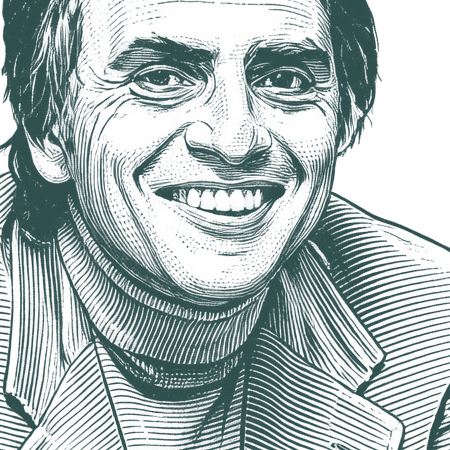
Carl Sagan
Carl Edward Sagan (9 November 1934 – 20 December 1996) was an American astronomer, planetary scientist, cosmologist, astrophysicist, astrobiologist, author, and science communicator. His best known scientific contribution is research on extraterrestrial life, including experimental demonstration of the production of amino acids from basic chemicals by radiation. Sagan assembled the first physical messages sent into space, the Pioneer plaque and the Voyager Golden Record, universal messages that could potentially be understood by any extraterrestrial intelligence that might find them. Sagan argued the hypothesis, accepted since, that the high surface temperatures of Venus can be attributed to, and calculated using, the greenhouse effect. He testified to the US Congress in 1985 that the greenhouse effect will change the earth's climate system.
Biography information from
Wikiquote·
Portrait adapted from
Wikimedia Commons, NASA/JPL (Public domain / CC0)
Also Known As
Native Name:
Carl Edward Sagan
Alternative Names:
Sagan
•
Carl E. Sagan
•
Carl E Sagan
•
C. E. Sagan
•
C.E. Sagan
•
C E Sagan
•
C. Sagan
•
C Sagan
•
Sagan C
•
Sagan C.
•
Sagan C. E.
•
Sagan CE
Consider again that dot. That's here. That's home. That's us. On it everyone you love, everyone you know, everyone you ever heard of, every human being who ever was, lived out their lives. The aggregate of our joy and suffering, thousands of confident religions, ideologies, and economic doctrines, every hunter and forager, every hero and coward, every creator and destroyer of civilization, every king and peasant, every young couple in love, every mother and father, hopeful child, inventor and explorer, every teacher of morals, every corrupt politician, every "superstar", every "supreme leader", every saint and sinner in the history of our species lived there — on a mote of dust suspended in a sunbeam. The Earth is a very small stage in a vast cosmic arena. Think of the rivers of blood spilled by all those generals and emperors so that, in glory and triumph, they could become the momentary masters of a fraction of a dot. Think of the endless cruelties visited by the inhabitants of one corner of this pixel on the scarcely distinguishable inhabitants of some other corner, how frequent their misunderstandings, how eager they are to kill one another, how fervent their hatreds. Our posturings, our imagined self-importance, the delusion that we have some privileged position in the Universe, are challenged by this point of pale light. Our planet is a lonely speck in the great enveloping cosmic dark. In our obscurity, in all this vastness, there is no hint that help will come from elsewhere to save us from ourselves. The Earth is the only world known so far to harbor life. There is nowhere else, at least in the near future, to which our species could migrate. Visit, yes. Settle, not yet. Like it or not, for the moment the Earth is where we make our stand. It has been said that astronomy is a humbling and character-building experience. There is perhaps no better demonstration of the folly of human conceits than this distant image of our tiny world. To me, it underscores our responsibility to deal more kindly with one another, and to preserve and cherish the pale blue dot, the only home we've ever known.
I would love to believe that when I die I will live again, that some thinking, feeling, remembering part of me will continue. But as much as I want to believe that, and despite the ancient and worldwide cultural traditions that assert an afterlife, I know of nothing to suggest that it is more than wishful thinking. I want to grow really old with my wife, Annie, whom I dearly love. I want to see my younger children grow up and to play a role in their character and intellectual development. I want to meet still unconceived grandchildren. There are scientific problems whose outcomes I long to witness — such as the exploration of many of the worlds in our Solar System and the search for life elsewhere. I want to learn how major trends in human history, both hopeful and worrisome, work themselves out: the dangers and promise of our technology, say; the emancipation of women; the growing political, economic, and technological ascendancy of China; interstellar flight. If there were life after death, I might, no matter when I die, satisfy most of these deep curiosities and longings. But if death is nothing more than an endless dreamless sleep, this is a forlorn hope. Maybe this perspective has given me a little extra motivation to stay alive. The world is so exquisite, with so much love and moral depth, that there is no reason to deceive ourselves with pretty stories for which there's little good evidence. Far better, it seems to me, in our vulnerability, is to look Death in the eye and to be grateful every day for the brief but magnificent opportunity that life provides.
Enhance Your Quote Experience
Enjoy ad-free browsing, unlimited collections, and advanced search features with Premium.