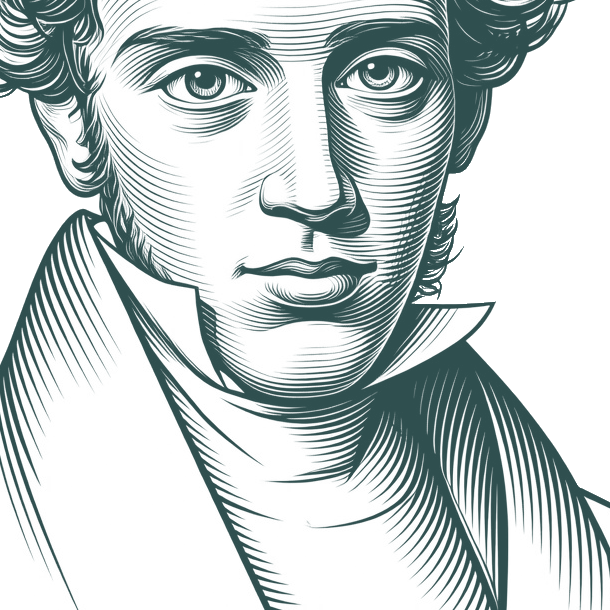
Riches and abundance come hypocritically clad in sheep's clothing, pretending to be security against anxieties, and they become then the object of an… - Søren Kierkegaard
""
Riches and abundance come hypocritically clad in sheep's clothing, pretending to be security against anxieties, and they become then the object of anxiety. They secure a man against anxieties just about as well as the wolf that is put to tending the sheep.
Søren Aabye Kierkegaard (5 May 1813 – 11 November 1855) was a Danish Christian philosopher and theologian, considered to be a founder of Existentialist thought and Absurdist traditions. He wrote critical texts on organized religion, Christendom, morality, ethics, psychology and philosophy of religion, displaying a fondness for metaphor, irony and parables.
Biography information from
Wikiquote·
Portrait adapted from
Wikimedia Commons, La Biblioteca Real de Dinamarca (Public domain / CC0)
Also Known As
Pen Names:
Victor Eremita
•
A
•
Judge William
•
Johannes de silentio
•
Constantine Constantius
•
Young Man
•
Vigilius Haufniensis
•
Nicolaus Notabene
•
Hilarius Bookbinder
•
Johannes Climacus
•
Inter et Inter
•
H.H.
•
Anti-Climacus
•
B
•
Johannes de Silentio
•
Constantin Constantius
•
P. CH. Kierkegaard
Native Name:
Søren Aabye Kierkegaard
Alternative Names:
Kierkegaard
•
Climacus
•
Sören Aaby Kierkegaard
An old proverb fetched from the outward and visible world says: "Only the man that works gets the bread." Strangely enough this proverb does not aptly apply in that world to which it expressly belongs. For the outward world is subjected to the law of imperfection, and again and again the experience is repeated that he too who does not work gets the bread, and that he who sleeps gets it more abundantly than the man who works. In the outward world everything is made payable to the bearer, this world is in bondage to the law of indifference, and to him who has the ring, the spirit of the ring is obedient, whether he be Noureddin or Aladdin, and he who has the world's treasure, has it, however he got it.
Death induces the sensual person to say: Let us eat and drink, because tomorrow we shall die – but this is sensuality's cowardly lust for life, that contemptible order of things where one lives in order to eat and drink instead of eating and drinking in order to live.
Works in ChatGPT, Claude, or Any AI
Add semantic quote search to your AI assistant via MCP. One command setup.
In the Church which was founded at Corinth, St. Paul had special difficulties of the kind I have mentioned. In that flourishing commercial city, which through its shipping and situation, maintained a vital connexion between East and West, numerous crowds of people flocked together from all quarters, different in speech and in culture. As they mingled with the inhabitants, they produced, by contacts and contrasts, new and ever new differences. Even in the Church this differentiation endeavoured to make itself felt in sects and parties; and a kind of pagan wisdom made a special attempt to force itself forward as a teacher of truth. In his first letter to this church, from which the text I read is taken, St. Paul strongly combats this tendency.