Friday night when I got home, my wife met me at the door. She said, "I just watched Vernon Jordan on television being interviewed and he said your ad… - Jimmy Carter
""
Friday night when I got home, my wife met me at the door. She said, "I just watched Vernon Jordan on television being interviewed and he said your administration is not doing anything for people who need help." And I read the New York Times yesterday and this morning, and my wife called me again this morning about 7:30. She says, "Vernon doesn't think you are doing as well as I think you are doing, Jimmy." And I hope in the months ahead that I'll be able to work closer with Vernon Jordan at the White House-where I spend a great deal of time working and planning with Members of the Congress. Parren Mitchell, the head of the Black Caucus, was in my office Thursday going over not only the accomplishments but the remaining needs that have been addressed and are being addressed by the Democratic Congress and the Democratic President. We haven't done everything we would like to do, nor have we done everything that we're going to do. I've been in office now 6 months--have no apologies to make--and I was trying to think of a story to illustrate that sometimes an immediate transformation can't be accomplished when problems have been there for years or terms of Presidents or even generations. Griffin Bell, who will speak to you later, has a favorite story about a man who was arrested for getting drunk and setting a bed on fire. When he got before the judge, he said, "Judge, I plead guilty to being drunk, but the bed was on fire when I got in it." Well, to some degree, the bed was on fire when I got in it. The point I want to make is that we're trying as best we can to make progress. I think you'll judge before this convention is over that I don't speak with a lonely voice, that the members of my Cabinet are united with me, and that there is no division between the Urban League and my administration. But we do need to have a closer working relationship because it's obvious that we have a long way to go. And we can get to our destination of having a decent life for all Americans if we work close together in a constructive and cooperative fashion.
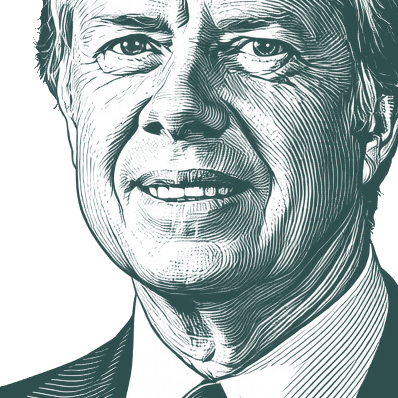
James Earl Carter, Jr. (October 1, 1924 – December 29, 2024) was an American politician and member of the Democratic Party who served as the 39th president of the United States from 1977 to 1981. In 1982 he established the Carter Center, as a base for promoting human rights, democracy, finding peaceful solutions to international conflicts, and advancing economic and social development, for which he was awarded the Nobel Peace Prize in 2002. He was a key figure in the Habitat for Humanity project, and has been noted for his criticism of Israel's role in the Israeli–Palestinian conflict.
Biography information from
Wikiquote·
Portrait adapted from
Wikimedia Commons, Department of Defense. Department of the Navy. Naval Photographic Center (Public domain / CC0)
Also Known As
Birth Name:
James Earl Carter Jr.
Alternative Names:
James E. Carter
•
James Carter
•
James Earl Carter
•
39th President of the United States
•
James E. Carter Jr.
•
James Earl Carter, Jr.
•
James E. Carter, Jr.
We've now finished a year as the administration in the White House and have learned a lot. I think I have a much better and easier and understanding relationship with the Congress, with my Cabinet-which I consider to be superb-and we've defined issues very carefully. We're trying to carry out our campaign commitments. There's a growing understanding among the American people of what we are trying to do. We're addressing some difficult questions that have been long unaddressed, or at least unsolved. We don't have any magic answers, but I think there's a growing comprehension around the world that we reestablished a true and accurate sense in foreign policy of what the American people stand for and what we want to have as a characteristic of our own Nation and our own Government. We're trying to guarantee peaceful resolution of any differences or competition with the Soviet Union. We're trying to add our good will and our good offices in the Middle East when the discussions lag or when there is a problem there in communication among the leaders. I think we are trusted, in general, by all of them who are seeking peace. We are strengthening our relationship and our involvement and interest in Africa. We've had a good response in Latin America, particularly as a result of successful negotiations with the Panama Canal treaties, which are now being considered by the Senate, as you know. As I pointed out in the State of the Union message, we had a very successful economic year in our country in 1977. But we still have some chronic problems, particularly unemployment among minority groups and young people and a general uncertainty about the economic future because of a lack of resolution of the energy question, that need to be addressed. We have gone through, now, one complete budget cycle. And I've put an enormous amount of time in, personally, in the evolution of the fiscal year '79 budget, more than I will for the 1980 or 1981 budgets, because I had to learn about the different, specific programs that are buried deep within the large number of Federal agencies. I think we have a good prospect of holding the budget basically where it is. It's a tight, conservative budget, but it meets the needs of our people adequately. We'll have an urban policy evolved early in the spring, and we have enough flexibility, I think, to accommodate the specific financial needs there.
I was very proud that Pete Flahetty came to work as a Deputy Attorney General. That was an an arrangement that was made really without my prior knowledge between the Attorney General and Pete Flaherty. Secondly, I did not know ahead of time that Pete was going to resign and go back to Pennsylvania. It was not a result of a dispute or an argument or an incompatibility between him and the Attorney General. It was an action taken by Pete on his own initiative. He did a very good job during the time that he was here. He was basically in charge of reorganization of the Department, doing some long-range studies for management reasons. I think he and the Attorney General were completely compatible. And the only, comments that the Attorney General has made to me were in praise of Flaherty. I have not talked to Pete. I got a written letter saying that he intended to resign, and I've written a letter back to him accepting his resignation and expressing my regret that he was leaving and my good wishes for the future. But he's not discussed with me any involvement in the campaign. My policy has been and will be not to involve myself in any sort of Democratic primary campaign. But I have habitually supported Democratic nominees, after they, were chosen, in a general election.
Try QuoteGPT
Chat naturally about what you need. Each answer links back to real quotes with citations.
My faith demands - this is not optional - my faith demands that I do whatever I can, wherever I can, whenever I can, for as long as I can with whatever I have to try to make a difference.