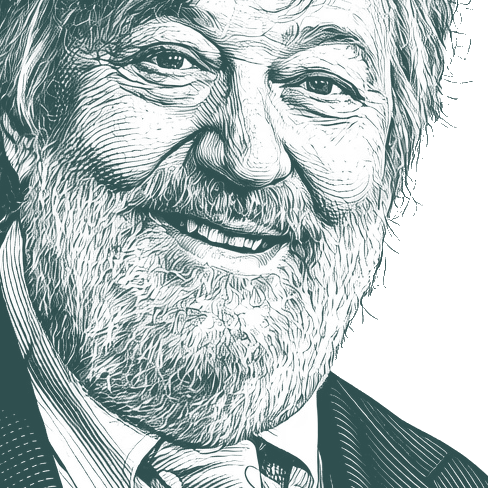
And then I saw him and nothing was ever the same again.
The sky was never the same colour, the moon never the same shape: the air never smelt the sa… - Stephen Fry
""
And then I saw him and nothing was ever the same again.
The sky was never the same colour, the moon never the same shape: the air never smelt the same, food never tasted the same. Every word I knew changed its meaning, everything that once was stable and firm became as insubstantial as a puff of wind, and every puff of wind became a solid thing I could feel and touch.
Sir Stephen John Fry (born 24 August 1957) is an English actor, broadcaster, comedian, director, narrator and writer. He first came to prominence as one half of the comic double act Fry and Laurie, alongside Hugh Laurie, with the two starring in A Bit of Fry & Laurie (1989–1995) and Jeeves and Wooster (1990–1993). He also starred in the sketch series Alfresco (1983–1984) alongside Laurie, Emma Thompson, and Robbie Coltrane and in Blackadder (1986–1989) alongside Rowan Atkinson. Since 2011 he has served as president of the mental health charity Mind. In 2025, he was knighted for services to mental health awareness, the environment and charity.
Fry's film acting roles include playing his idol Oscar Wilde in the film Wilde (1997), for which he was nominated for the Golden Globe Award for Best Actor; Inspector Thompson in Robert Altman's murder mystery Gosford Park (2001); and Mr. Johnson in Whit Stillman's Love & Friendship (2016). He has also had roles in the films Chariots of Fire (1981), A Fish Called Wanda (1988), The Life and Death of Peter Sellers (2004), V for Vendetta (2005), and Sherlock Holmes: A Game of Shadows (2011). He portrays the Cheshire Cat in Alice in Wonderland (2010) and its 2016 sequel, and the Master of Lake-town in the film series adaptation of The Hobbit. Between 2001 and 2017, he hosted the British Academy Film Awards 12 times.
Fry's television roles include Lord Melchett in the BBC television comedy series Blackadder, the title character in the television series Kingdom, as well as recurring guest roles as Dr. Gordon Wyatt on the American crime series Bones and Arthur Garrison MP on the Channel 4 period drama It's a Sin. He has also written and presented several documentary series, including the Emmy Award-winning Stephen Fry: The Secret Life of the Manic Depressive, which saw him explore his bipolar disorder, and the travel series Stephen Fry in America. He was the longtime host of the BBC television quiz show QI, with his tenure lasting from 2003 to 2016, during which he was nominated for six British Academy Television Awards. He appears frequently on other panel games, such as the radio programmes Just a Minute and I'm Sorry I Haven't a Clue. In 2006, the British public ranked Fry number 9 in ITV's poll of TV's 50 Greatest Stars.
Biography information from
Wikipedia·
Portrait adapted from
Wikimedia Commons, Elena Ternovaja (CC BY-SA)
Also Known As
Birth Name:
Stephen John Fry
Alternative Names:
Sir Stephen Fry
•
Sir Stephen John Fry
For some reason the word “chronic” often has to be explained. It does not mean severe, though many chronic conditions can be exceptionally serious and indeed life-threatening. No, “chronic” means persistent over time, enduring, constant. Diabetes is a chronic condition, but measles is not. With measles, you contract it and then it is gone. It can sometimes be fatal, but is never chronic. Manic depression, in other words, is something you have to learn to live with. There are therapies which may help some people to function and function for the most part happily and well. Sometimes a talking therapy, sometimes pharmaceutical intervention helps.
There are all kinds of pedants around with more time to read and imitate Lynne Truss and John Humphrys than to write poems, love-letters, novels and stories it seems. They whip out their Sharpies and take away and add apostrophes from public signs, shake their heads at prepositions which end sentences and mutter at split infinitives and misspellings, but do they bubble and froth and slobber and cream with joy at language? Do they ever let the tripping of the tips of their tongues against the tops of their teeth transport them to giddy euphoric bliss? Do they ever yoke impossible words together for the sound-sex of it? Do they use language to seduce, charm, excite, please, affirm and tickle those they talk to? Do they? I doubt it. They’re too farting busy sneering at a greengrocer’s less than perfect use of the apostrophe. Well sod them to Hades. They think they’re guardians of language. They’re no more guardians of language than the Kennel Club is the guardian of dogkind.
Try QuoteGPT
Chat naturally about what you need. Each answer links back to real quotes with citations.
All gone. All anger quelled, all desire drained, all thirst slaked, all madness past.