Russian dramatist and author (1860–1904)
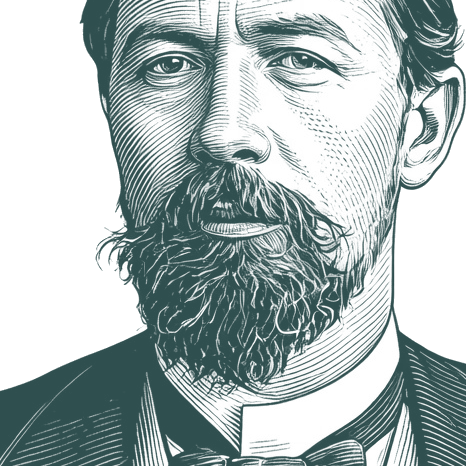
Anton Pavlovich Chekhov (Анто́н Па́влович Че́хов) (29 January 1860 – 15 July 1904) (Old Style: 17 January 1860 – 2 July 1904) was a Russian short story writer and playwright.
Bio from: Wikiquote (CC BY-SA 4.0) · Portrait adapted from: Wikimedia Commons (Public domain / CC0)
From Wikidata (CC0)
Try QuoteGPT
Chat naturally about what you need. Each answer links back to real quotes with citations.
Anna Petrovna: Do you know what, Kolya? Try and sing, laugh, get angry, as you once did... You stay in, we'll laugh and drink fruit liqueur and we'll drive away your depression in a flash. I'll sing if you like. Or else let's go and sit in the dark in your study as we used to, and you'll tell me about your depression... You have such suffering eyes. I'll look into them and cry, and we'll both feel better.
Between "there is a God" and "there is no God" lies a whole vast tract, which the really wise man crosses with great effort. A Russian knows one or other of these two extremes, and the middle tract between them does not interest him; and therefore he usually knows nothing, or very little. (Diary, 1897)
Advanced Search Filters
Filter search results by source, date, and more with our premium search tools.
Works in ChatGPT, Claude, or Any AI
Add semantic quote search to your AI assistant via MCP. One command setup.
I walked by an old white house of two storeys with a terrace, and there suddenly opened before me a view of a courtyard, a large pond with a bathing-house, a group of green willows, and a village on the further bank, with a high, narrow belfry on which there glittered a cross reflecting the setting sun. For a moment it breathed upon me the fascination of something near and very familiar, as though I had seen that landscape at some time in my childhood.
[Ognev] recalled endless, heated, purely Russian arguments, when the wranglers, spraying spittle and banging their fists on the table, fail to understand yet interrupt one another, themselves not even noticing it, contradict themselves with every phrase, change the subject, then, having argued for two or three hours, begin to laugh.