This is not always clearly seen. It is true today as when Thomas Jefferson first said it, that people generally have more feeling for canals and the … - Lyndon B. Johnson
""
This is not always clearly seen. It is true today as when Thomas Jefferson first said it, that people generally have more feeling for canals and the roads than they do for education. But I hold the hope that Jefferson held, that we can advance them with equal pace. In our cities and in our counties, and in all of our country, there is a very great and urgent need for public works. But today more than any time in our history, America's most urgent work is educating its people, educating all the people, all the time, wherever they may have been born or wherever they may have chosen to live.
English
Collect this quote
About
Lyndon B. Johnson
Lyndon Baines Johnson (27 August 1908 – 22 January 1973), often referred to by his initials LBJ, was an American politician. After a long career in U.S. legislatures, Johnson became the vice president of the United States of America under John F. Kennedy, from 1961 to 1963. A Democrat, Johnson became the 36th U.S. president in 1963, after Kennedy's assassination. He served in the role until 1969.
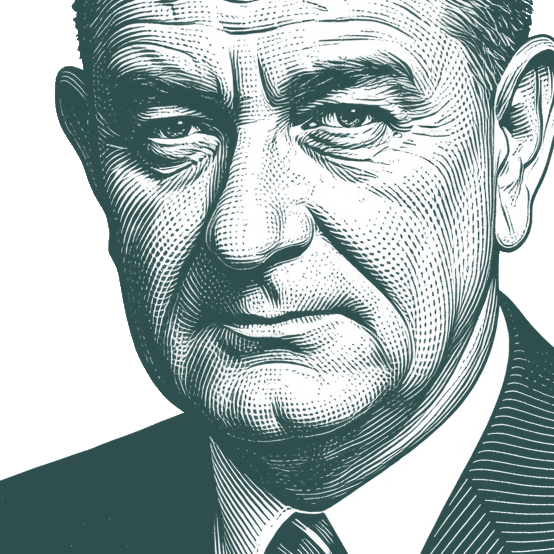
Portrait adapted from
Wikimedia Commons, Arnold Newman (Public domain / CC0)
Also Known As
Native Name:
Lyndon Baines Johnson
Also Known As:LBJ
Alternative Names:
Lyndon Johnson
•
President Johnson
•
L. B. Johnson
I will propose a Highway Safety Act of 1966 to seek an end to this mounting tragedy. We must also act to prevent the deception of the American consumer—requiring all packages to state clearly and truthfully their contents—all interest and credit charges to be fully revealed—and keeping harmful drugs and cosmetics away from our stores. It is the genius of our Constitution that under its shelter of enduring institutions and rooted principles there is ample room for the rich fertility of American political invention. We must change to master change. I propose to take steps to modernize and streamline the executive branch, to modernize the relations between city and state and nation. A new Department of Transportation is needed to bring together our transportation activities. The present structure—35 government agencies, spending $5 billion yearly—makes it almost impossible to serve either the growing demands of this great nation or the needs of the industry, or the right of the taxpayer to full efficiency and real frugality. I will propose in addition a program to construct and to flight-test a new supersonic transport airplane that will fly three times the speed of sound—in excess of 2,000 miles per hour. I propose to examine our federal system-the relation between city, state, nation, and the citizens themselves. We need a commission of the most distinguished scholars and men of public affairs to do this job. I will ask them to move on to develop a creative federalism to best use the wonderful diversity of our institutions and our people to solve the problems and to fulfill the dreams of the American people. As the process of election becomes more complex and more costly, we must make it possible for those without personal wealth to enter public life without being obligated to a few large contributors. Therefore, I will submit legislation to revise the present unrealistic restriction on contributions—to prohibit the endless proliferation of committees, bringing local and state committees under the act—to attach strong teeth and severe penalties to the requirement of full disclosure of contributions—and to broaden the participation of the people, through added tax incentives, to stimulate small contributions to the party and to the candidate of their choice.
We have in 1964 a unique opportunity and obligation--to prove the success of our system; to disprove those cynics and critics at home and abroad who question our purpose and our competence. If we fail, if we fritter and fumble away our opportunity in needless, senseless quarrels between Democrats and Republicans, or between the House and the Senate, or between the South and North, or between the Congress and the administration, then history will rightfully judge us harshly. But if we succeed, if we can achieve these goals by forging in this country a greater sense of union, then, and only then, can we take full satisfaction in the State of the Union.
A third area of increasing strength is the struggle against subversion. Our adversaries, convinced that direct attack would be aimless, today resort to terror, subversion, and guerrilla warfare. To meet this threat we began a large effort to train special forces to fight internal subversion. Since January 1961 we have increased these specialized forces eight times. We have trained more than 100,000 officers in these techniques. We have given special emphasis to this form of warfare in the training of all military units. Our army now has six special action forces on call around the world to assist our friendly nations. They are skilled in the languages and problems of the area in which they are stationed. The Navy and the Air Force have several thousand men whose abilities, training, equipment, and mission are designed to combat clandestine attack. And behind these groups are five brigade-size backup forces ready to move into instant action. But just as subversion has many faces, our responses must take many forms. We have worked to increase and integrate all the resources, political and social as well as military and economic, needed to meet a threat which tears at the entire fabric of a society. But success in fighting subversion ultimately rests on the skill of the soldiers of the threatened country. We now have 344 teams at work in 49 countries to train the local military in the most advanced techniques of internal defense. Subversive warfare is often difficult, dirty, and deadly. Victory comes only to those with the desire to protect their own freedom. But such conflict requires weapons as well as will, ability as well as aspiration. And we will continue to increase this strength until our adversaries are convinced that this course too will not lead to conquest.