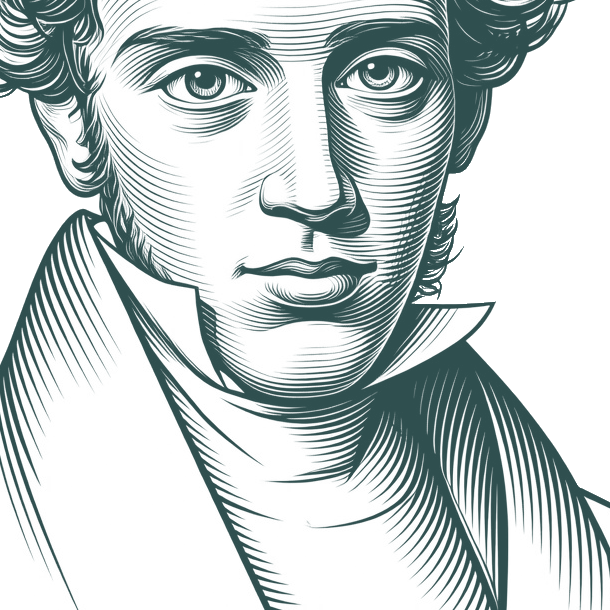
My grief is my castle, which like an eagle's nest is built high up on the mountain peaks among the clouds; nothing can storm it. From it I fly down i… - Søren Kierkegaard
""
My grief is my castle, which like an eagle's nest is built high up on the mountain peaks among the clouds; nothing can storm it. From it I fly down into reality to seize my prey; but i do not remain down there, I bring it home with me, and this prey is a picture I weave into the tapestries of my palace. There I live as one dead. I immerse everything I have experienced in a baptism of forgetfulness unto an eternal remembrance. Everything finite and accidental is forgotten and erased. Then I sit like an old man, grey-haired and thoughtful, and explain the pictures in a voice as soft as a whisper; and at my side a child sits and listens, although he remembers everything before I tell it.
English
Collect this quote
About
Søren Kierkegaard
Søren Aabye Kierkegaard (5 May 1813 – 11 November 1855) was a Danish Christian philosopher and theologian, considered to be a founder of Existentialist thought and Absurdist traditions. He wrote critical texts on organized religion, Christendom, morality, ethics, psychology and philosophy of religion, displaying a fondness for metaphor, irony and parables.
Biography information from
Wikiquote·
Portrait adapted from
Wikimedia Commons, La Biblioteca Real de Dinamarca (Public domain / CC0)
Also Known As
Pen Names:
Victor Eremita
•
A
•
Judge William
•
Johannes de silentio
•
Constantine Constantius
•
Young Man
•
Vigilius Haufniensis
•
Nicolaus Notabene
•
Hilarius Bookbinder
•
Johannes Climacus
•
Inter et Inter
•
H.H.
•
Anti-Climacus
•
B
•
Johannes de Silentio
•
Constantin Constantius
•
P. CH. Kierkegaard
Native Name:
Søren Aabye Kierkegaard
Alternative Names:
Kierkegaard
•
Climacus
•
Sören Aaby Kierkegaard
بی شک هیچ گاه عشق را تجربه نکرده؛ روحش بیش از آن آزاد است که عاشق بوده باشد.
One could construe the life of man as a great discourse in which the various people represent different parts of speech (the same might apply to states). How many people are just adjectives, interjections, conjunctions, adverbs? How few are substantives, active verbs, how many are copulas? Human relations are like the irregular verbs in a number of languages where nearly all verbs are irregular.
When I get up in the morning, I go right back to bed again. I feel best in the evening the moment I put out the light and pull the feather-bed over my head. I sit up once more, look around the room with indescribable satisfaction, and then good night, down under the feather-bed.