This year we must continue to improve the quality of American life. Let us fulfill and improve the great health and education programs of last year, … - Lyndon B. Johnson
""
This year we must continue to improve the quality of American life. Let us fulfill and improve the great health and education programs of last year, extending special opportunities to those who risk their lives in our armed forces. I urge the House of Representatives to complete action on three programs already passed by the Senate—the Teacher Corps, rent assistance, and home rule for the District of Columbia. In some of our urban areas we must help rebuild entire sections and neighborhoods containing, in some cases, as many as 100,000 people. Working together, private enterprise and government must press forward with the task of providing homes and shops, parks and hospitals, and all the other necessary parts of a flourishing community where our people can come to live the good life. I will offer other proposals to stimulate and to reward planning for the growth of entire metropolitan areas. Of all the reckless devastations of our national heritage, none is really more shameful than the continued poisoning of our rivers and our air. We must undertake a cooperative effort to end pollution in several river basins, making additional funds available to help draw the plans and construct the plants that are necessary to make the waters of our entire river systems clean, and make them a source of pleasure and beauty for all of our people. To attack and to overcome growing crime and lawlessness, I think we must have a stepped-up program to help modernize and strengthen our local police forces. Our people have a right to feel secure in their homes and on their streets—and that right just must be secured. Nor can we fail to arrest the destruction of life and property on our highways.
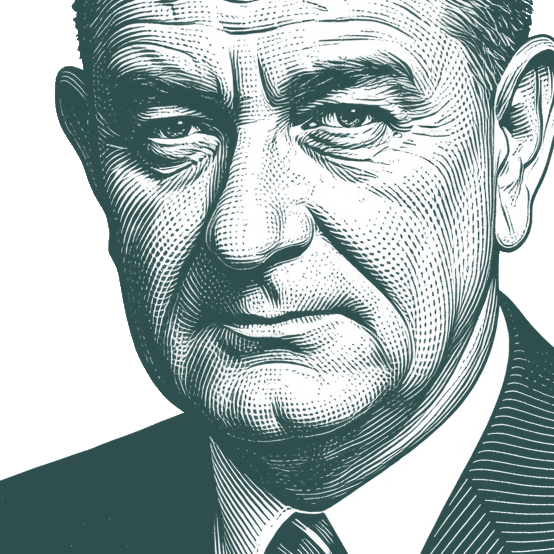
Lyndon Baines Johnson (27 August 1908 – 22 January 1973), often referred to by his initials LBJ, was an American politician. After a long career in U.S. legislatures, Johnson became the vice president of the United States of America under John F. Kennedy, from 1961 to 1963. A Democrat, Johnson became the 36th U.S. president in 1963, after Kennedy's assassination. He served in the role until 1969.
Portrait adapted from
Wikimedia Commons, Arnold Newman (Public domain / CC0)
Also Known As
Native Name:
Lyndon Baines Johnson
Also Known As:LBJ
Alternative Names:
Lyndon Johnson
•
President Johnson
•
L. B. Johnson
The fifth area and the most important of increasing strength is the ability of the American fighting man. However impressive or ingenious, our weapons can be no better than the men who man them. The complexities of modern weapons require men of high skill. The complexities of modern warfare require men of great knowledge. The complexities of the modern world require men of broad outlook. Today 52 percent of our enlisted men are under 25 and are high school graduates, compared with 39 percent in the country as a whole who are high school graduates. Sixty-five percent of our commissioned officers are college graduates today, compared with 7 percent in the Nation. Twenty-five thousand officers hold graduate degrees and thousands more are studying for such degrees. In encampments across the world millions of men and women have chosen to serve with low pay and high hazard, with deep devotion and silent sacrifice, so that their fellow Americans might enjoy the rich legacy of liberty. They stand the hard vigil that we may pursue the high vision of flourishing freedom in a world at peace. These are the sources of the strength we build, knowing, in the words of the Bible, "When the strong man armed keepeth his palace, his goods are in peace." The necessities of our strength are as varied as the nature of our dangers. The response must suit the threat. Those who would answer every problem with nuclear weapons display not bravery but bravado, not wisdom but a wanton disregard for the survival of the world and the future of the race.
Third, I ask for the authority to recruit and train skilled volunteers for the war against poverty. Thousands of Americans have volunteered to serve the needs of other lands. Thousands more want the chance to serve the needs of their own land. They should have that chance. Among older people who have retired, as well as among the young, among women as well as men, there are many Americans who are ready to enlist in our war against poverty. They have skills and dedication. They are badly needed. If the State requests them, if the community needs and will use them, we will recruit and train them and give them the chance to serve.
Go Premium
Support Quotewise while enjoying an ad-free experience and premium features.
Conflict among nations will trouble this planet and will test our patience for a long time to come. And as long as weapons are necessary, wisdom in their control is going to be needed. The man who guides them holds in his hands the hopes of survival for the entire world. As I exercise my cares every day and every night, I often think of those who have just begun and those who are yet unborn. I want them to have a chance. With all my power, and all the aid the good Lord offers me, I will help give them that chance. And I think so will all of you.