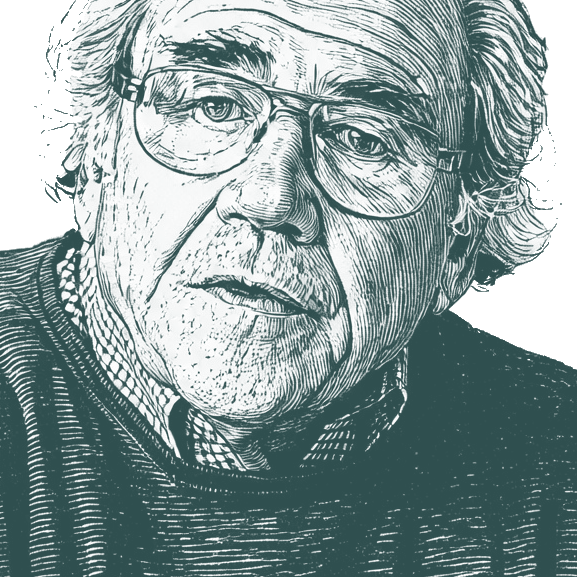
(27 July 1929 – 6 March 2007) was a French sociologist, philosopher, cultural theorist, political commentator, and photographer. His work is frequently associated with postmodernism and specifically post-structuralism.
Portrait adapted from
Wikimedia Commons, http://en.wikipedia.org/wiki/User:Ayaleila (CC BY-SA)
Disneyland exists in order to hide that it is the "real" country, all of "real" America that is Disneyland (a bit like prisons are there to hide that it is the social in its entirety, in its banal omnipresence, that is carceral). Disneyland is presented as imaginary in order to make us believe that the rest is real.
Fascism itself, the mystery of its appearance and of its collective energy, with which no interpretation has been able to come to grips (neither the Marxist one of political manipulation by dominant classes, nor the Reichian one of the sexual repression of the masses, nor the Deleuzian one of despotic paranoia), can already be interpreted as the "irrational" excess of mythic and political referentials, the mad intensification of collective value (blood, race, people, etc.), the reinjection of death, of a "political aesthetic of death" at a time when the process of the disenchantment of value and of collective values, of the rational secularization and unidimensionalization of all life, of the operationalization of all social and individual life already makes itself strongly felt in the West. Yet again, everything seems to escape this catastrophe of value, this neutralization and pacification of life. Fascism is a resistance to this, even if it is a profound, irrational, demented resistance, it would not have tapped into this massive energy if it hadn't been a resistance to something much worse. Fascism's cruelty, its terror is on the level of this other terror that is the confusion of the real and the rational, which deepened in the West, and it is a response to that.
PREMIUM FEATURE
Advanced Search Filters
Filter search results by source, date, and more with our premium search tools.
There are cultures that can only picture their origins and not their ends. Some are obsessed by both. Two other positions are possible: only picturing one's end - our own culture; picturing neither beginning nor end - the coming culture.