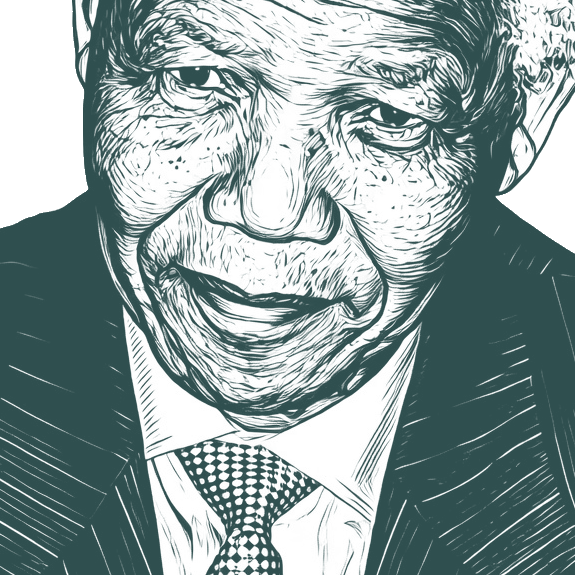
For to be free is not merely to cast off one’s chains, but to live in a way that respects and enhances the freedom of others. - Nelson Mandela
""
For to be free is not merely to cast off one’s chains, but to live in a way that respects and enhances the freedom of others.
English
Collect this quote
About
Nelson Mandela
Nelson Rolihlahla Mandela (18 July 1918 – 5 December 2013) was a South African anti-apartheid revolutionary, politician, and philanthropist, who served as President of South Africa from 1994 to 1999. He was the country's first black chief executive, and the first elected in a fully representative democratic election. His government focused on dismantling the legacy of apartheid through tackling institutionalised racism and fostering racial reconciliation. Politically an African nationalist and democratic socialist, he served as President of the African National Congress (ANC) party from 1991 to 1997. He was the co-winner of the Nobel Peace Prize with F.W. de Klerk in 1993.
Biography information from
Wikiquote·
Portrait adapted from
Wikimedia Commons, Kingkongphoto & www.celebrity-photos.com from Laurel (CC BY-SA)
Also Known As
Native Name:
Nelson Rolihlahla Mandela
Alternative Names:
Mandela
•
Prisoner 46664
•
Madiba
•
Rolihllahla
•
Rolihllahla Mandela
•
Father of the Nation
Success in politics demands that you must take your people into confidence about your views and state them very clearly, very politely, very calmly, but nevertheless, state them openly.
Men, I think, are not capable of doing nothing, of saying nothing, of not reacting to injustice, of not protesting against oppression, of not striving for the good of society and the good life in the ways they see it.
Try QuoteGPT
Chat naturally about what you need. Each answer links back to real quotes with citations.
I have already mentioned that I was one of the persons who helped to form Umkhonto. I, and the others who started the organization, did so for two reasons. Firstly, we believed that as a result of Government policy, violence by the African people had become inevitable, and that unless responsible leadership was given to canalize and control the feelings of our people, there would be outbreaks of terrorism which would produce an intensity of bitterness and hostility between the various races of this country which is not produced even by war. Secondly, we felt that without violence there would be no way open to the African people to succeed in their struggle against the principle of white supremacy. All lawful modes of expressing opposition to this principle had been closed by legislation, and we were placed in a position in which we had either to accept a permanent state of inferiority, or to defy the Government. We chose to defy the law. We first broke the law in a way which avoided any recourse to violence; when this form was legislated against, and then the Government resorted to a show of force to crush opposition to its policies, only then did we decide to answer violence with violence...