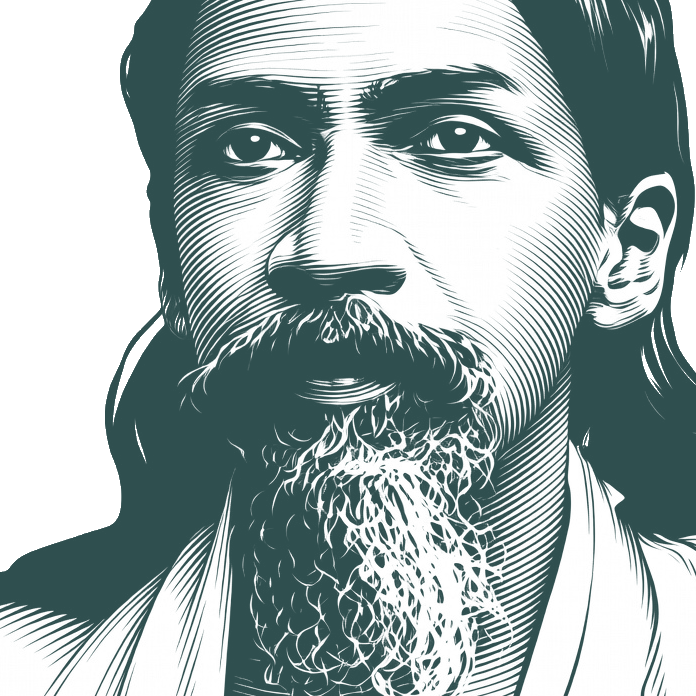
The Mahomedan or Islamic culture hardly gave anything to the world which may be said to be of fundamental importance and typically its own; Islamic c… - Aurobindo Ghosh
""
The Mahomedan or Islamic culture hardly gave anything to the world which may be said to be of fundamental importance and typically its own; Islamic culture was mainly borrowed from others. Their mathematics and astronomy and other subjects were derived from India and Greece. It is true they gave some of these things a new turn, but they have not created much. Their philosophy and their religion are very simple and what they call Sufism is largely the result of gnostics who lived in Persia and it is the logical outcome of that school of thought largely touched by Vedanta.... I have, however, mentioned [in The Foundations of Indian Culture] that Islamic culture contributed the Indo-Saracenic architecture to Indian culture. I do not think it has done anything more in India of cultural value. It gave some new forms to art and poetry. Its political institutions were always semi-barbaric.
Sri Aurobindo [born Aravinda Akroyd Ghose] (15 August 1872 – 5 December 1950) was an Indian nationalist, scholar, poet, mystic, philosopher, yogi and guru, who developed concepts of human progress and spiritual evolution. With the help of his spiritual collaborator, Mirra Alfassa, he founded the Sri Aurobindo Ashram.
Biography information from
Wikiquote·
Portrait adapted from
Wikimedia Commons, Rudolf 1922 (Public domain / CC0)
Also Known As
Native Name:
অরবিন্দ ঘোষ
Alternative Names:
Sri Aurobindo Ghose
•
Sri Orobindo
•
Orobindo Ghosh
•
Shri Aurobindo
•
Aurobindo Ghose
•
Sri Aurobindo
•
Aurobindo
•
Aravinda Ackroyd Ghose
•
A.A.Ghosh
•
A.G.
•
Maharshi Aravind Babu
I waited day and night for the voice of God within me, to know what He had to say to me, to learn what I had to do. In this seclusion the earliest realisation, the first lesson came to me. I remembered then that a month or more before my arrest, a call had come to me to put aside all activity, to go in seclusion and to look into myself, so that I might enter into closer communion with Him. I was weak and could not accept the call. My work was very dear to me and in the pride of my heart I thought that unless I was there, it would suffer or even fail and cease; therefore I would not leave it. It seemed to me that He spoke to me again and said, "The bonds you had not the strength to break, I have broken for you, because it is not my will nor was it ever my intention that that should continue. I have had another thing for you to do and it is for that I have brought you here, to teach you what you could not learn for yourself and to train you for my work." Then He placed the Gita in my hands. His strength entered into me and I was able to do the sadhana of the Gita. I was not only to understand intellectually but to realise what Sri Krishna demanded of Arjuna and what He demands of those who aspire to do His work, to be free from repulsion and desire, to do work for Him without the demand for fruit, to renounce self-will and become a passive and faithful instrument in His hands, to have an equal heart for high and low, friend and opponent, success and failure, yet not to do His work negligently. I realised what the Hindu religion meant. We speak often of the Hindu religion, of the Sanatan Dharma, but few of us really know what that religion is. Other religions are preponderatingly religions of faith and profession, but the Sanatan Dharma is life itself; it is a thing that has not so much to be believed as lived. This is the Dharma that for the salvation of humanity was cherished in the seclusion of this peninsula from of old. It is to give this religion that India is rising. She does not rise as other countries do, for self or when she is strong, to trample on the weak. She is rising to shed the eternal light entrusted to her over the world. India has always existed for humanity and not for herself and it is for humanity and not for herself that she must be great.
There is no logical necessity for the conclusion that the change cannot begin at all because its perfection is not immediately possible.
Unlimited Quote Collections
Organize your favorite quotes without limits. Create themed collections for every occasion with Premium.
The seers of ancient India had, in their experiments and efforts at spiritual training and the conquest of the body, perfected a discovery which in its importance to the future of human knowledge dwarfs the divinations of Newton and Galileo, even the discovery of the inductive and experimental method in Science was not more momentous...