Perhaps I shouldn't call it shit. That's a bit crude. I don't really despise Christianity or even the Roman Church, and certainly not the incontrover… - Edward Abbey
""
Perhaps I shouldn't call it shit. That's a bit crude. I don't really despise Christianity or even the Roman Church, and certainly not the incontrovertible glory of the Middle Ages. What I do despise is the contemporary inclination to flop to the knees and crawl back into the past, to shy from what seem like impossible problems in order to bury the head, asshole aloft and twitching, in the Sands of Time. Cowardice, I calls it. Illusion-seeking. Womb-crawling. And treason. Desertion in the face of the enemy. Strong words indeed. But I've always been rather a blunt, tough, plain-spoken type . . .
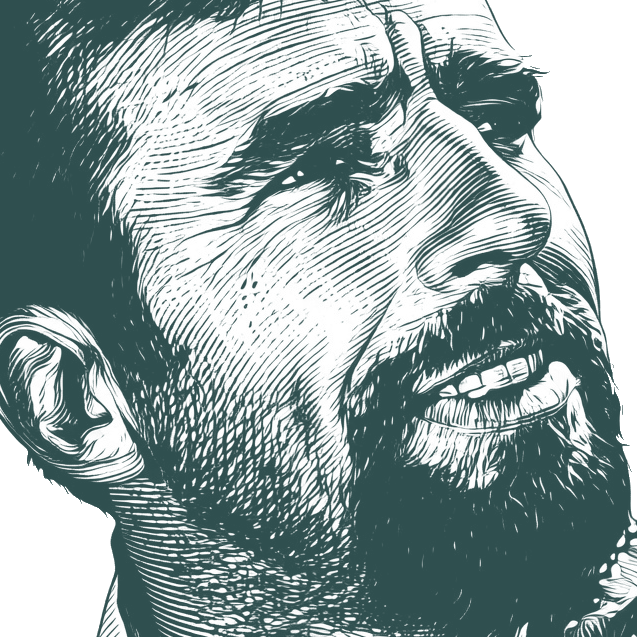
Edward Paul Abbey (29 January 1927 – 14 March 1989) was an American writer noted for his advocacy of environmental issues and criticism of public land policies.
Biography information from
Wikiquote·
Portrait adapted from
Wikimedia Commons, Photo by Woody Hilbert (Public domain / CC0)
Suppose we were planning to impose a dictatorial regime upon the American people — the following preparations would be essential: 1. Concentrate the populace in megalopolitan masses so that they can be kept under close surveillance and where, in case of trouble, they can be bombed, burned, gassed or machine-gunned with a minimum of expense and waste. 2. Mechanize agriculture to the highest degree of refinement, thus forcing most of the scattered farm and ranching population into the cities. Such a policy is desirable because farmers, woodsmen, cowboys, Indians, fishermen and other relatively self-sufficient types are difficult to manage unless displaced from their natural environment. 3. Restrict the possession of firearms to the police and the regular military organizations. 4. Encourage or at least fail to discourage population growth. Large masses of people are more easily manipulated and dominated than scattered individuals. 5. Continue military conscription. Nothing excels military training for creating in young men an attitude of prompt, cheerful obedience to officially constituted authority. 6. Divert attention from deep conflicts within the society by engaging in foreign wars; make support of these wars a test of loyalty, thereby exposing and isolating potential opposition to the new order. 7. Overlay the nation with a finely reticulated network of communications, airlines and interstate autobahns. 8. Raze the wilderness. Dam the rivers, flood the canyons, drain the swamps, log the forests, strip-mine the hills, bulldoze the mountains, irrigate the deserts and improve the national parks into national parking lots. Idle speculations, feeble and hopeless protest. It was all foreseen nearly half a century ago by the most cold-eyed and clear-eyed of our national poets, on California’s shore, at the end of the open road. Shine, perishing republic.
But why, the questioner insists, why do people like you pretend to love uninhabited country so much? Why this cult of wilderness? Why the surly hatred of progress and development, the churlish resistance to all popular improvements? Very well, a fair question, but it’s been asked and answered a thousand times already; enough books to drive a man stark naked mad have dealt in detail with the question. There are many answers, all good, each sufficient. Peace is often mentioned; beauty; spiritual refreshment, whatever that means; re-creation for the soul, whatever that is; escape; novelty, the delight of something different; truth and understanding and wisdom — commendable virtues in any man, anytime; ecology and all that, meaning the salvation of variety, diversity, possibility and potentiality, the preservation of the genetic reservoir, the answers to questions that we have not yet even learned to ask, a connection to the origin of things, an opening into the future, a source of sanity for the present — all true, all wonderful, all more than enough to answer such a dumb dead degrading question as “Why wilderness?” To which, nevertheless, I shall append one further answer anyway: because we like the taste of freedom; because we like the smell of danger
Works in ChatGPT, Claude, or Any AI
Add semantic quote search to your AI assistant via MCP. One command setup.