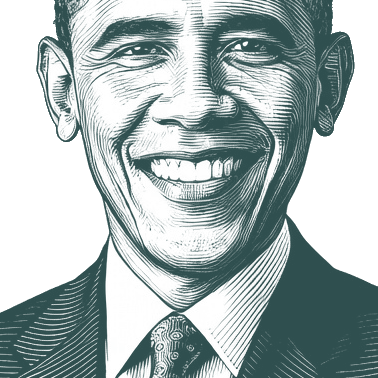
My name may not be on the ballot, but our progress is on the ballot. Tolerance is on the ballot. Democracy is on the ballot. Justice is on the ballot… - Barack Obama
""
My name may not be on the ballot, but our progress is on the ballot. Tolerance is on the ballot. Democracy is on the ballot. Justice is on the ballot. Good schools are on the ballot. Ending mass incarceration – that's on the ballot right now! And there is one candidate who will advance those things. And there's another candidate whose defining principle, the central theme of his candidacy is opposition to all that we've done. There's no such thing as a vote that doesn't matter. It all matters. And after we have achieved historic turnout in 2008 and 2012, especially in the African-American community, I will consider it a personal insult, an insult to my legacy, if this community lets down its guard and fails to activate itself in this election. You want to give me a good sendoff? Go vote.
Barack Hussein Obama II (born August 4, 1961) is an American politician who served as the 44th president of the United States of America from 2009 to 2017. Born in Hawaii, the son of a Kenyan father and a mother from Kansas, he won the 2008 presidential election and was re-elected president in November 2012. A member of the U.S. Democratic Party, he was the first African American president. Before becoming president, he represented the 13th district for three terms in the Illinois Senate from 1997 to 2004 and served as United States senator from Illinois between January 4, 2005 and November 16, 2008. While president, he was the recipient of the 2009 Nobel Peace Prize.
Biography information from
Wikiquote·
Portrait adapted from
Wikimedia Commons, Official White House Photo by Pete Souza (Public domain / CC0)
Also Known As
Birth Name:
Barack Hussein Obama II
Also Known As:Barry
Alternative Names:
POTUS 44
•
Barack Hussein Obama
•
Barack H. Obama
•
Barack Hussein Obama, Jr.
•
Barack H Obama
•
Barak Obama
•
Barry Obama
•
Barack Obama II
The American people will say a prayer for Boston tonight. And Michelle and I send our deepest thoughts and prayers to the families of the victims in the wake of this senseless loss...We still do not know who did this or why. And people shouldn’t jump to conclusions before we have all the facts. But make no mistake - we will get to the bottom of this. And we will find out who did this; we'll find out why they did this. Any responsible individuals, any responsible groups will feel the full weight of justice.
On paper, at least, none of this would necessarily stop us from getting a stimulus bill passed. After all, Democrats enjoyed a seventy-seven-seat majority in the House and a seventeen-seat majority in the Senate. But even in the best of circumstances, trying to get the largest emergency spending bill in history through Congress in record time would be a little like getting a python to swallow a cow. I also had to contend with a bit of institutionalized procedural mischief — the Senate filibuster — which in the end would prove to be the most chronic political headache of my presidency. The filibuster isn’t mentioned anywhere in the Constitution. Instead, it came into being by happenstance: In 1805, Vice President Aaron Burr urged the Senate to eliminate the “motion to proceed” — a standard parliamentary provision that allows a simple majority of any legislature to end debate on a piece of business and call for a vote. (Burr, who seems never to have developed the habit of thinking things through, reportedly considered the rule a waste of time.) It didn’t take long for senators to figure out that without a formal way to end debate, any one of them could bring Senate business to a halt — and thereby extract all sorts of concessions from frustrated colleagues — simply by talking endlessly and refusing to surrender the floor. In 1917, the Senate curbed the practice by adopting “cloture,” allowing a vote of two-thirds of senators present to end a filibuster. For the next fifty years the filibuster was used only sparingly — most notably by southern Democrats attempting to block anti-lynching and fair-employment bills or other legislation that threatened to shake up Jim Crow. Gradually, though, the filibuster became more routinized and easier to maintain, making it a more potent weapon, a means for the minority party to get its way. The mere threat of a filibuster was often enough to derail a piece of legislation. By the 1990s, as battle lines between Republicans and Democra
Go Premium
Support Quotewise while enjoying an ad-free experience and premium features.
Four years ago, I stood in Cairo in front of an audience of young people -- politically, religiously, they must seem a world away. But the things they want, they’re not so different from what the young people here want. They want the ability to make their own decisions and to get an education, get a good job; to worship God in their own way; to get married; to raise a family. The same is true of those young Palestinians that I met with this morning. The same is true for young Palestinians who yearn for a better life in Gaza. That's where peace begins -- not just in the plans of leaders, but in the hearts of people. Not just in some carefully designed process, but in the daily connections -- that sense of empathy that takes place among those who live together in this land and in this sacred city of Jerusalem.