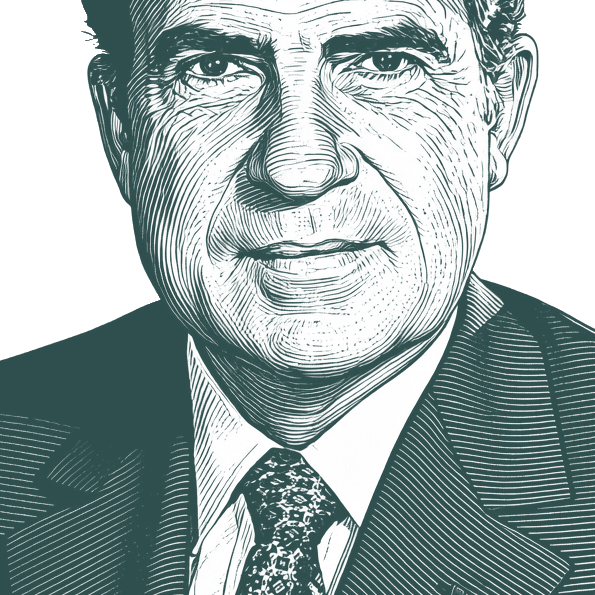
But if we are to command from the younger generation coming along, and from people generally, that deep feeling of pride and patriotism which we all … - Richard Nixon
""
But if we are to command from the younger generation coming along, and from people generally, that deep feeling of pride and patriotism which we all want, we have to do everything that we can to make our country lovely so that people will love this country and love it very deeply. They will love this country even when it has some unlovely characteristics. There is no question about that. But how much we can do, how much you can do, as we look to the future 10 years, 90 years, down to the end of this century, how much we can do to see that the America that is built will be a new America, a new America in terms not only of the tremendous concentration of population in our cities-and I have spoken to that point in visits to various departments--how we must plan now for transportation and housing and all of the other areas which will determine the character of our cities in the future, which will be one and a half times as big as they are 15 years from now, but we must also think of the character of that great part of America that is called rural America, the part that you mainly deal with, our water, our land, our resources, everything that really makes America a lovely country, one that gives you a feeling as you move out through the western part of this Nation and up to Alaska and out to Hawaii, a feeling of patriotism, of love of country that goes beyond simply seeing the flag, that goes beyond simply reading our history, that recognizes that we are fortunate to live in a country that was so richly blessed as this country has been blessed with natural resources.
Richard Milhous Nixon (9 January 1913 – 22 April 1994) was the 37th president of the United States, serving from 1969 to 1974, when he became the only president to resign the office. Nixon had previously served as a Republican U.S. representative and senator from California from 1947 to 1952 and as the 36th vice president of the United States from 1953 to 1961.
Portrait adapted from
Wikimedia Commons, Department of Defense. Department of the Army. Office of the Deputy Chief of Staff for Operations. U.S. Army Audiovisual Center. (ca. 1974 - 05/15/1984) (Public domain / CC0)
Also Known As
Birth Name:
Richard Milhous Nixon
Also Known As:Dick Nixon
Alternative Names:
Nixon
•
President Nixon
•
R. Nixon
•
R. M. Nixon
•
Richard M. Nixon
•
Tricky Dick
•
President Richard Nixon
I don't think women should be in any government job whatever. I mean, I really don't. The reason why I do is mainly because they are erratic and emotional.
Now it is not my purpose here tonight to discuss the extent to which we consider the various charges that I have just listed right or wrong. But I recognize the concerns. I share many of them. What I propose tonight is, I believe, responsive to those concerns. The most pressing concerns center on economic development and especially on the policies by which aid is administered and by which trade is regulated. In proposing specific changes tonight, I mean these as examples of the actions I believe are possible in a new kind of partnership in the Americas. Our partnership should be one in which the United States lectures less and listens more. It should be one in which clear, consistent procedures are established to insure that the shaping of the future of the nations in the Americas reflects the will of those nations. I believe this requires a number of changes. To begin with, it requires a fundamental change in the way in which we manage development assistance in the hemisphere. That is why I propose that a multilateral inter-American agency be given an increasing share of responsibility for development assistance decisions. CIAP-the Inter-American Committee on the Alliance for Progress--could be given this new function, or an entirely new agency could be created within the system. Whatever the form, the objective would be to evolve an effective multilateral framework for bilateral assistance, to provide the agency with an expert international staff and, over time, to give it major operational and decision making responsibilities. The other American nations themselves would thus jointly assume a primary role in setting priorities within the hemisphere, in developing realistic programs, in keeping their own performance under critical review.
In the age of nuclear warfare to continue our political differences by means of war would be to discontinue civilization as we know it. War is an option whose time has passed. Peace is the only option for the future. At present we occupy a treacherous no-man’s-land between peace and war, a time of growing fear that our military might has expanded beyond our capacity to control it and our political differences widened beyond our ability to bridge them.