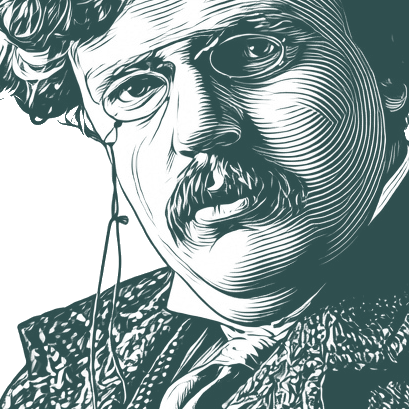
If our life is ever really as beautiful as a fairy-tale, we shall have to remember that all the beauty of a fairy-tale lies in this: that the prince … - G. K. Chesterton
""
If our life is ever really as beautiful as a fairy-tale, we shall have to remember that all the beauty of a fairy-tale lies in this: that the prince has a wonder which just stops short of being fear. If he is afraid of the giant, there is an end of him; but also if he is not astonished at the giant, there is an end of the fairy-tale. The whole point depends upon his being at once humble enough to wonder, and haughty enough to defy. So our attitude to the giant of the world must not merely be increasing delicacy or increasing contempt: it must be one particular proportion of the two–which is exactly right.
We must have in us enough reverence for all things outside us to make us tread fearfully on the grass. We must also have enough disdain for all things outside us, to make us, on due occasion, spit at the stars. Yet these two things (if we are to be good or happy) must be combined, not in any combination, but in one particular combination. The perfect happiness of men on the earth (if it ever comes) will not be a flat and solid thing, like the satisfaction of animals. It will be an exact and perilous balance; like that of a desperate romance. Man must have just enough faith in himself to have adventures, and just enough doubt of himself to enjoy them.
Gilbert Keith Chesterton (29 May 1874 – 14 June 1936) was a British writer whose prolific and diverse output included works of philosophy, ontology, poetry, play writing, journalism, public lecturing and debating, literary and art criticism, biography, Christian apologetics (particularly for Catholicism), and fiction, including fantasy and detective fiction. He has been called the "prince of paradox".
Biography information from
Wikiquote·
Portrait adapted from
Wikimedia Commons, Ernest Herbert Mills (Public domain / CC0)
Also Known As
Native Name:
Gilbert Keith Chesterton
Alternative Names:
František Kafka
•
Kafka
•
Gilbert K. Chesterton
•
Gilbert Chesterton
•
G.K. Chesterton
•
G. K. C.
I tell you naught for your comfort, Yea, naught for your desire, Save that the sky grows darker yet And the sea rises higher.
But the new rebel is a skeptic, and will not entirely trust anything. He has no loyalty; therefore he can never be really a revolutionist. And the fact that he doubts everything really gets in his way when he wants to denounce anything. For all denunciation implies a moral doctrine of some kind; and the modern revolutionist doubts not only the institution he denounces, but the doctrine by which he denounces it. . . . As a politician, he will cry out that war is a waste of life, and then, as a philosopher, that all life is waste of time. A Russian pessimist will denounce a policeman for killing a peasant, and then prove by the highest philosophical principles that the peasant ought to have killed himself. . . . The man of this school goes first to a political meeting, where he complains that savages are treated as if they were beasts; then he takes his hat and umbrella and goes on to a scientific meeting, where he proves that they practically are beasts. In short, the modern revolutionist, being an infinite skeptic, is always engaged in undermining his own mines. In his book on politics he attacks men for trampling on morality; in his book on ethics he attacks morality for trampling on men. Therefore the modern man in revolt has become practically useless for all purposes of revolt. By rebelling against everything he has lost his right to rebel against anything.
Go Premium
Support Quotewise while enjoying an ad-free experience and premium features.
Shall I tell you the secret of the whole world? It is that we have only known the back of the world. We see everything from behind, and it looks brutal. That is not a tree, but the back of a tree. That is not a cloud, but the back of a cloud. Cannot you see that everything is stooping and hiding a face? If we could only get round in front —