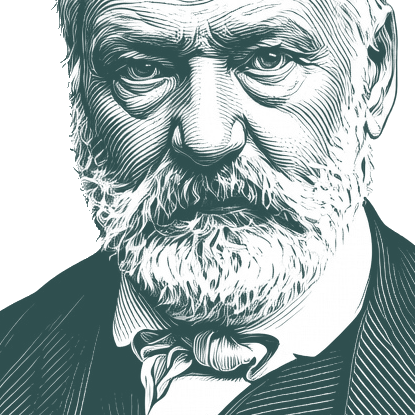
Victor Marie Hugo (26 February 1802 – 22 May 1885) was a French poet, novelist, and dramatist of the Romantic movement, widely esteemed as one of the greatest of French writers and poets.
Biography information from
Wikiquote·
Portrait adapted from
Wikimedia Commons, Étienne Carjat (Public domain / CC0)
Also Known As
Alternative Names:
Victor Marie Hugo
•
Homme océan
•
Ocean Man
•
Victor-Marie Hugo
Cosette, in her seclusion, like Marius in his, was all ready to take fire. Destiny, with its mysterious and fatal patience, was slowly bringing these two beings near each other, fully charged and all languishing with the stormy electricities of passion, — these two souls which held love as two clouds hold lightning, and which were to meet and mingle in a glace like clouds in a flash.
The power of a glance has been so much abused in love stories, that it has come to be disbelieved in. Few people dare now to say that two beings have fallen in love because they have looked at each other. Yet it is in this way that love begins, and in this way only. The rest is only the rest, and comes afterwards. Nothing is more real than these great shocks which two souls give each other in exchanging this spark.
At that particular moment when Cosette unconsciously looked with this glance which so affected Marius, Marius had no suspicion that he also had a glance which affected Cosette.
There was a nation among the nations, which was a sort of elder brother in this family of the oppressed, a prophet in the human tribe. This nation took the initiative of the whole human movement. It went on, saying, "Come!" and the rest followed. As a complement to the fraternity of men, in the Gospel, it taught the fraternity of nations. It spoke by the voice of its writers, of its poets, of its philosophers, of its orators, as by a single mouth, and its words flew to the extremities of the earth, to rest, like tongues of fire, upon the brow of all nations. It presided over the communion of intellects. Conclusion, Part Second, I
Go Premium
Support Quotewise while enjoying an ad-free experience and premium features.