This new consensus seemed so compelling that Ernst Mayr, the dean of modern Darwinians, opened the ashcan of history for a deposit of Geoffrey's idea… - Stephen Jay Gould
""
This new consensus seemed so compelling that Ernst Mayr, the dean of modern Darwinians, opened the ashcan of history for a deposit of Geoffrey's ideas about anatomical unity.
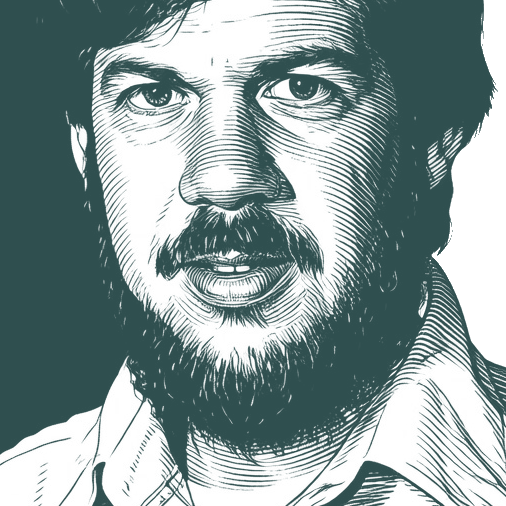
Stephen Jay Gould (September 10, 1941 – May 20, 2002) was an American geologist, paleontologist, evolutionary biologist and popular-science author, who spent most of his career teaching at Harvard University and working at the American Museum of Natural History in New York. He was one of the most influential and widely read writers of popular science of his generation.
Biography information from
Wikiquote·
Portrait adapted from
Wikimedia Commons, Lawrence Lipke (Public domain / CC0)
But our strong desire to identify trends often leads us to detect a directionality that doesn’t exist, or to infer causes that cannot be sustained. The subject of trends has inspired and illustrated some of the classic fallacies in human reasoning. Most prominently, since people seem to be so bad at thinking about probability and so prone to read pattern into sequence of events, we often commit the fallacy of spotting a “sure” trend in speculating about causes, when we observe no more than a random string of happenings.
[T]ruly grand and powerful theories […] do not and cannot rest upon single observations. Evolution is an inference from thousands of independent sources, the only conceptual structure that can make unified sense of all this disparate information. The failure of a particular claim usually records a local error, not the bankruptcy of a central theory. […] If I mistakenly identify your father's brother as your own dad, you don't become genealogically rootless and created de novo. You still have a father; we just haven't located him properly.
Works in ChatGPT, Claude, or Any AI
Add semantic quote search to your AI assistant via MCP. One command setup.
We can now determine, easily and relatively cheaply, the detailed chemical architecture of genes; and we can trace the products of these genes (enzymes and proteins) as they influence the course of embryology. In so doing we have made the astounding discovery that all complex animal phyla - arthropods and vertebrates in particular - have retained, despite their half-billion years of evolutionary independence, an extensive set of common genetic blueprints for building bodies.