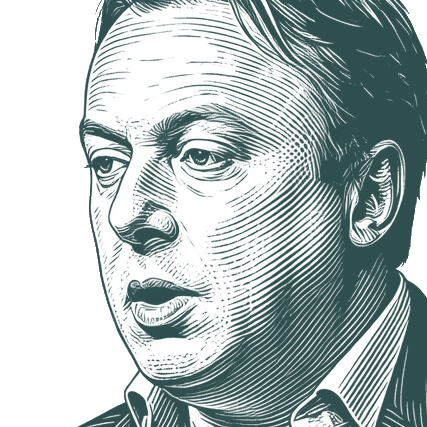
That most risky and volatile of all things—a self-pitying majority. - Christopher Hitchens
""
That most risky and volatile of all things—a self-pitying majority.
English
Collect this quote
About
Christopher Hitchens
Christopher Eric Hitchens (13 April 1949 – 15 December 2011) was an-English-American journalist and writer. He contributed to the New Statesman, The Nation, The Atlantic, London Review of Books, The Times Literary Supplement, Slate, and Vanity Fair. Hitchens was the author, co-author, editor or co-editor of over 30 books, including five collections of essays, on a range of subjects, including politics, literature, and religion. A staple of talk shows and lecture circuits, his confrontational style of debate made him both a lauded and controversial figure and public intellectual.
[I]f you think that American imperialism and its globalised, capitalist form is the most dangerous thing in the world, that means you don't think the Islamic Republic of Iran or North Korea or the Taliban is as bad.
The conservative aptitude for stressing the "individual responsibility" of all parties except themselves.
Limited Time Offer
Premium members can get their quote collection automatically imported into their Quotewise collections.
So, whenever the subject of Iraq came up, as it did keep on doing through the Clinton years, I had no excuse for not knowing the following things: I knew that its one-party, one-leader state machine was modeled on the precedents of both National Socialism and Stalinism, to say nothing of Al Capone. I knew that its police force was searching for psychopathic killers and sadistic serial murderers, not in order to arrest them but to employ them. I knew that its vast patrimony of oil wealth, far from being 'nationalized,' had been privatized for the use of one family, and was being squandered on hideous ostentation at home and militarism abroad. (Post-Kuwait inspections by the United Nations had uncovered a huge nuclear-reactor site that had not even been known about by the international community.) I had seen with my own eyes the evidence of a serious breach of the Genocide Convention on Iraqi soil, and I had also seen with my own eyes the evidence that it had been carried out in part with the use of weapons of mass destruction. I was, if you like, the prisoner of this knowledge. I certainly did not have the option of un-knowing it.