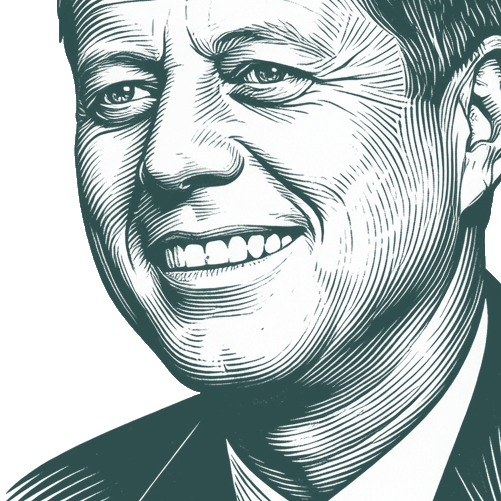
I am convinced that the enactment this year of tax reduction and tax reform overshadows all other domestic problems in this Congress. For we cannot f… - John F. Kennedy
""
I am convinced that the enactment this year of tax reduction and tax reform overshadows all other domestic problems in this Congress. For we cannot for long lead the cause of peace and freedom, if we ever cease to set the pace here at home. For we cannot for long lead the cause of peace and freedom, if we ever cease to set the pace here at home.
John Fitzgerald Kennedy (29 May 1917 – 22 November 1963), often referred to by his initials JFK and Jack, was the 35th president of the United States (1961–1963), a United States senator from Massachusetts (1953–1960), and a United States representative (1947–1953). Kennedy served at the height of the Cold War, and the majority of his work as president concerned relations with the Soviet Union and Cuba. He is the older brother of Robert F. Kennedy and Ted Kennedy, and the first husband of Jacqueline Kennedy Onassis. He was shot in the presence of his wife in Dallas on November 22, 1963.
Portrait adapted from
Wikimedia Commons, Cecil W. Stoughton (Public domain / CC0)
Also Known As
Birth Name:
John Fitzgerald Kennedy
Also Known As:Jack
Alternative Names:
Kennedy
•
Jack Kennedy
•
President Kennedy
•
J. F. Kennedy
•
JFK
•
John Kennedy
•
John Fitzgerald "Jack" Kennedy
•
JF Kennedy
•
John F Kennedy
Finally, if we are to win the battle that is now going on around the world between freedom and tyranny, the dramatic achievements in space which occurred in recent weeks should have made clear to us all, as did the Sputnik in 1957, the impact of this adventure on the minds of men everywhere, who are attempting to make a determination of which road they should take. [...] Now it is time to take longer strides — time for a great new American enterprise — time for this nation to take a clearly leading role in space achievement, which in many ways may hold the key to our future on earth. I believe we possess all the resources and talents necessary. But the facts of the matter are that we have never made the national decisions or marshaled the national resources required for such leadership. We have never specified long-range goals on an urgent time schedule, or managed our resources and our time so as to insure theft fulfillment. Recognizing the head start obtained by the Soviets with their large rocket engines, which gives them many months of lead-time, and recognizing the likelihood that they will exploit this lead for some time to come in still more impressive successes, we nevertheless are required to make new efforts on our own. For while we cannot guarantee that we shall one day be first, we can guarantee that any failure to make this effort will make us last. We take an additional risk by making it in full view of the world, but as shown by feat of astronaut Shepard, this very risk enhances our stature when we are successful. But this is not merely a race. Space is open to us now; and our eagerness to share its meaning is not governed by the efforts of others. We go into space because whatever mankind must undertake, free men must fully share.
I want to point out that we have increased in conventional forces in the last 2 years the number of our divisions from 11 to 16, and we are also providing equipment for 22 divisions in case it were necessary to mobilize our Guard. We have six divisions in Europe, and we have the equipment for two more. Now, I think the Cuban incident indicated the importance of a strong conventional force. The greatest factor on our side was the fact that we had superior conventional strength on the scene, and it would have been necessary to equalize that strength for the Soviets to initiate the use of nuclear weapons, which of course they were quite reluctant to do.
Enhance Your Quote Experience
Enjoy ad-free browsing, unlimited collections, and advanced search features with Premium.
The United Nations cannot survive as a static organization. Its obligations are increasing as well as its size. Its Charter must be changed as well as its customs. The authors of that Charter did not intend that it be frozen in perpetuity. The science of weapons and war has made us all, far more than 18 years ago in San Francisco, one world and one human race, with one common destiny. In such a world, absolute sovereignty no longer assures us of absolute security. The conventions of peace must pull abreast and then ahead of the inventions of war. The United Nations, building on its successes and learning from its failures, must be developed into a genuine world security system.