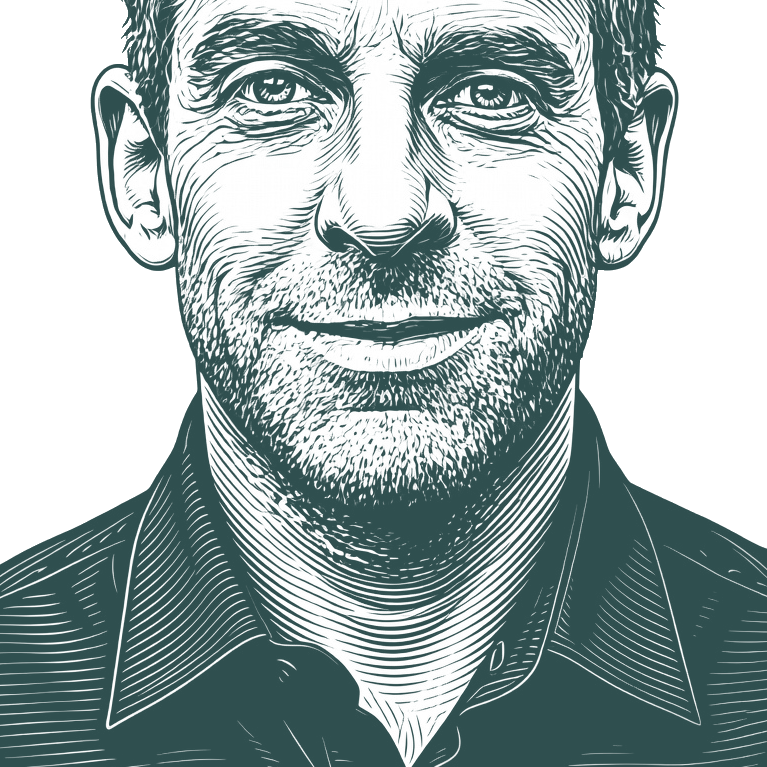
It has long been known that stress, especially early in life, alters brain structure. For instance, studies both in animals and in humans have shown … - Sam Harris
""
It has long been known that stress, especially early in life, alters brain structure. For instance, studies both in animals and in humans have shown that early stress increases the size of the amygdalae. One study found that an eight-week program of mindfulness meditation reduced the volume of the right basolateral amygdala, and these changes were correlated with a subjective decrease in stress.
English
Collect this quote
About
Sam Harris
Samuel Benjamin Harris (born April 9, 1967) is an American author, philosopher, public intellectual, and neuroscientist, as well as the co-founder and CEO of Project Reason. He is the author of The End of Faith (2004), which won the PEN/Martha Albrand Award for First Nonfiction in 2005 and appeared on The New York Times best seller list for 33 weeks, Letter to a Christian Nation (2006), The Moral Landscape (2010), Lying (2011), Free Will (2012), and most recently Waking Up: A Guide to Spirituality Without Religion (2014).
Biography information from
Wikiquote·
Portrait adapted from
Wikimedia Commons, Cmichel67 (Christopher Michel) (CC BY-SA)
[I]n the present moment, when (your mind) remains in its own condition without constructing anything, Awareness at that moment in itself is quite ordinary. And when you look into yourself in this way nakedly (without any discursive thoughts), Since there is only this pure observing, there will be found a lucid clarity without anyone being there who is the observer; Only a naked manifest awareness is present. (This awareness) is empty and immaculately pure, not being created by anything whatsoever. It is authentic and unadulterated, without any duality of clarity and emptiness. It is not permanent and yet it is not created by anything. However, it is not a mere nothingness or something annihilated because it is lucid and present. It does not exist as a single entity because it is present and clear in terms of being many. (On the other hand) it is not created as a multiplicity of things because it is inseparable and of a single flavor. This inherent self-awareness does not derive from anything outside itself. This is the real introduction to the actual condition of things. — Padmasambhava13
Just as we perceive the outside world on the basis of sensory signals met with a top-down flow of perceptual expectations and predictions, the same applies to perceptions of the internal state of the body. The brain has to know what the internal state of the body is like. It doesn’t have direct access to it, even though both the brain and body happen to be wrapped within a single layer of skin. As with perception of the outside world, all the brain gets from the inside of the body are noisy, ambiguous electrical signals. Therefore it has to bring to bear predictions and expectations in order to make sense of the barrage of sensory signals coming from inside the body, in just the same way as for vision and all the other “classic” senses. And this is what’s collectively called interoception — perception of the body from within. The same computational principles apply. In this view, we can think of emotional conscious experiences, feeling states, in the framework of “interoceptive inference.” So emotions become predictions — “best guesses” — about the hidden causes of interoceptive signals, in the same way that experiences of the outside world are constituted by predictions of the causes of sensory signals. This gives a nice computational and mechanistic gloss to old theories of emotion that originated with William James and Karl Lange — that emotion has to do with perception of physiological change in the body and by the subsequent cognitive “appraisal” of these changes. The predictive-processing view adds to these theories by saying that emotional experience is the joint content of predictions about the causes of interoceptive signals at all levels of abstraction.
Unlimited Quote Collections
Organize your favorite quotes without limits. Create themed collections for every occasion with Premium.
Your mind is the basis of everything you experience and of every contribution you make to the lives of others. Given this fact, it makes sense to train it.