Any the smallest alteration of my silent daily habits produces anarchy in me - Thomas Carlyle
""
Any the smallest alteration of my silent daily habits produces anarchy in me
English
Collect this quote
About
Thomas Carlyle
Thomas Carlyle (December 4 1795 – February 5 1881) was a Scottish essayist, historian and philosopher of great prominence during the Victorian era. His wife was Jane Welsh Carlyle.
Biography information from
Wikiquote·
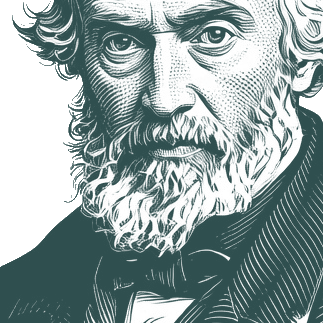
Portrait adapted from
Wikimedia Commons, Sir John Everett Millais, 1st Bt (died 1896) (Public domain / CC0)
Portrait from Wikimedia Commons. Credit: Sir John Everett Millais, 1st Bt (died 1896). Used under Public domain / CC0. Processed and styled by Quotewise.
Unlimited Quote Collections
Organize your favorite quotes without limits. Create themed collections for every occasion with Premium.
But I liken common languid Times, with their unbelief, distress, perplexity, with their languid doubting characters and embarrassed circumstances, impotently crumbling down into ever worse distress towards final ruin;—all this I liken to dry dead fuel, waiting for the lightning out of Heaven that shall kindle it. The great man, with his free force direct out of God's own hand, is the lightning. His word is the wise healing word which all can believe in. All blazes round him now, when he has once struck on it, into fire like his own.
All old Poems, Homer's and the rest, are authentically Songs. I would say, in strictness, that all right Poems are; that whatsoever is not sung is properly no Poem, but a piece of Prose cramped into jingling lines,—to the great injury of the grammar, to the great grief of the reader, for most part! What we wants to get at is the thought the man had, if he had any: why should he twist it into jingle, if he could speak it out plainly? It is only when the heart of him is rapt into true passion of melody, and the very tones of him, according to Coleridge's remark, become musical by the greatness, depth and music of his thoughts, that we can give him right to rhyme and sing; that we call him a Poet, and listen to him as the Heroic of Speakers,—whose speech is Song.
Go Premium
Support Quotewise while enjoying an ad-free experience and premium features.