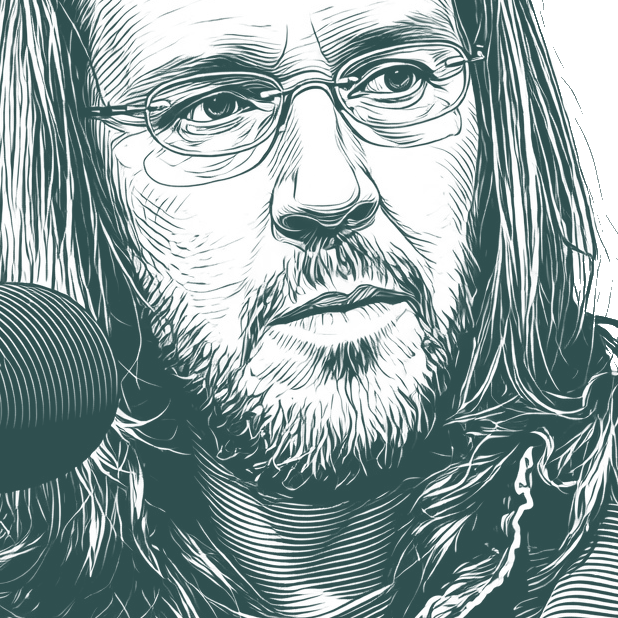
David Foster Wallace (21 February 1962 – 12 September 2008) was an American novelist, essayist, and short story writer. His works include The Broom of the System (novel), Infinite Jest (novel), The Girl With Curious Hair (short story collection), Brief Interviews with Hideous Men (short story collection), A Supposedly Fun Thing I'll Never Do Again (essay collection), and the posthumously-published The Pale King (novel) and Both Flesh and Not (essay collection).
We all have our little solipsistic delusions, ghastly intuitions of utter singularity: that we are the only one in the house who ever fills the ice-cube tray, who unloads the clean dishwasher, who occasionally pees in the shower, whose eyelid twitches on first dates; that only we take casualness terribly seriously; that only we fashion supplication into courtesy; that only we hear the whiny pathos in a dog’s yawn, the timeless sigh in the opening of the hermetically-sealed jar, the splattered laugh in the frying egg, the minor-D lament in the vacuum’s scream; that only we feel the panic at sunset the rookie kindergartner feels at his mother’s retreat. That only we love the only-we. That only we need the only-we. Solipsism binds us together, J.D. knows. That we feel lonely in a crowd; stop not to dwell on what’s brought the crowd into being. That we are, always, faces in a crowd.
Mediocrity is contextual.
Limited Time Offer
Premium members can get their quote collection automatically imported into their Quotewise collections.
For me, the last few years of the postmodern era have seemed a bit like the way you feel when you're in high school and your parents go on a trip, and you throw a party. You get all your friends over and throw this wild disgusting fabulous party. For a while it's great, free and freeing, parental authority gone and overthrown, a cat's-away-let's-play Dionysian revel. But then time passes and the party gets louder and louder, and you run out of drugs, and nobody's got any money for more drugs, and things get broken and spilled, and there's cigarette burn on the couch, and you're the host and it's your house too, and you gradually start wishing your parents would come back and restore some fucking order in your house. It's not a perfect analogy, but the sense I get of my generation of writers and intellectuals or whatever is that it's 3:00 A.M. and the couch has several burn-holes and somebody's thrown up in the umbrella stand and we're wishing the revel would end. The postmodern founders' patricidal work was great, but patricide produces orphans, and no amount of revelry can make up for the fact that writers my age have been literary orphans throughout our formative years. We're kind of wishing some parents would come back. And of course we're uneasy about the fact that we wish they'd come back — I mean, what's wrong with us? Are we total pussies? Is there something about authority and limits we actually need? And then the uneasiest feeling of all, as we start gradually to realize that parents in fact aren't ever coming back — which means we're going to have to be the parents.