It is easy to demonstrate that "our Fathers, who framed this government under which we live," looked on Slavery as wrong, and so framed it and everyt… - Abraham Lincoln
""
It is easy to demonstrate that "our Fathers, who framed this government under which we live," looked on Slavery as wrong, and so framed it and everything about it as to square with the idea that it was wrong, so far as the necessities arising from its existence permitted. In forming the Constitution they found the slave trade existing; capital invested in it; fields depending upon it for labor, and the whole system resting upon the importation of slave-labor. They therefore did not prohibit the slave trade at once, but they gave the power to prohibit it after twenty years. Why was this? What other foreign trade did they treat in that way? Would they have done this if they had not thought slavery wrong? Another thing was done by some of the same men who framed the Constitution, and afterwards adopted as their own act by the first Congress held under that Constitution, of which many of the framers were members; they prohibited the spread of Slavery into Territories. Thus the same men, the framers of the Constitution, cut off the supply and prohibited the spread of Slavery, and both acts show conclusively that they considered that the thing was wrong. If additional proof is wanting it can be found in the phraseology of the Constitution. When men are framing a supreme law and chart of government, to secure blessings and prosperity to untold generations yet to come, they use language as short and direct and plain as can be found, to express their meaning. In all matters but this of Slavery the framers of the Constitution used the very clearest, shortest, and most direct language. But the Constitution alludes to Slavery three times without mentioning it once! The language used becomes ambiguous, roundabout, and mystical. They speak of the "immigration of persons," and mean the importation of slaves, but do not say so. In establishing a basis of representation they say "all other persons," when they mean to say slaves — why did they not use the shortest phrase? In providing for the return of fugitives they say "persons held to service or labor." If they had said slaves it would have been plainer, and less liable to misconstruction. Why didn't they do it. We cannot doubt that it was done on purpose. Only one reason is possible, and that is supplied us by one of the framers of the Constitution — and it is not possible for man to conceive of any other — they expected and desired that the system would come to an end, and meant that when it did, the Constitution should not show that there ever had been a slave in this good free country of ours!
English
Collect this quote
About
Abraham Lincoln
Abraham Lincoln (12 February 1809 – 15 April 1865) was the 16th president of the United States, serving from March 1861 until his assassination in April 1865. Initially entering politics as a Whig, he became a member of the US congress from Illinois, and later the first Republican president, leading Union forces throughout the moral, constitutional, political and military crises of the American Civil War, during which he abolished slavery and strengthened the U.S. government.
Biography information from
Wikiquote·
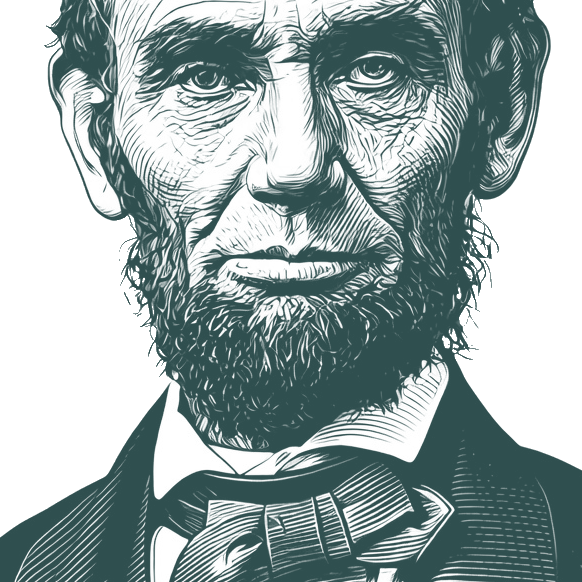
Portrait adapted from
Wikimedia Commons, Alexander Gardner (Public domain / CC0)
Also Known As
Alternative Names:
Honest Abe
•
President Lincoln
•
Abe Lincoln
•
Uncle Abe
•
A. Lincoln
•
Lincoln
Our republican robe is soiled, and trailed in the dust. Let us repurify it. Let us turn and wash it white, in the spirit, if not the blood, of the Revolution. Let us turn slavery from its claims of “moral right,” back upon its existing legal rights, and its arguments of 'necessity'. Let us return it to the position our fathers gave it; and there let it rest in peace. Let us re-adopt the Declaration of Independence, and with it, the practices, and policy, which harmonize with it. Let north and south — let all Americans — let all lovers of liberty everywhere — join in the great and good work. If we do this, we shall not only have saved the Union; but we shall have so saved it, as to make, and to keep it, forever worthy of the saving. We shall have so saved it, that the succeeding millions of free happy people, the world over, shall rise up, and call us blessed, to the latest generations.
خير لك أن تظل صامتا ويظن الآخرون أنك أبله، من أن تتكلم فتؤكد تلك الظنون
Unlimited Quote Collections
Organize your favorite quotes without limits. Create themed collections for every occasion with Premium.
I think the authors of that notable instrument intended to include all men, but they did not intend to declare all men equal in all respects. They did not mean to say all were equal in color, size, intellect, moral developments, or social capacity. They defined with tolerable distinctness, in what respects they did consider all men created equal; equal in "certain inalienable rights, among which are life, liberty, and the pursuit of happiness." This they said, and this meant. They did not mean to assert the obvious untruth, that all were then actually enjoying that equality, nor yet, that they were about to confer it immediately upon them. In fact they had no power to confer such a boon. They meant simply to declare the right, so that the enforcement of it might follow as fast as circumstances should permit. They meant to set up a standard maxim for free society, which should be familiar to all, and revered by all; constantly looked to, constantly labored for, and even though never perfectly attained, constantly approximated, and thereby constantly spreading and deepening its influence, and augmenting the happiness and value of life to all people of all colors everywhere. The assertion that "all men are created equal" was of no practical use in effecting our separation from Great Britain; and it was placed in the Declaration, nor for that, but for future use. Its authors meant it to be, thank God, it is now proving itself, a stumbling block to those who in after times might seek to turn a free people back into the hateful paths of despotism. They knew the proneness of prosperity to breed tyrants, and they meant when such should re-appear in this fair land and commence their vocation they should find left for them at least one hard nut to crack. I have now briefly expressed my view of the meaning and objects of that part of the Declaration of Independence which declares that "all men are created equal".