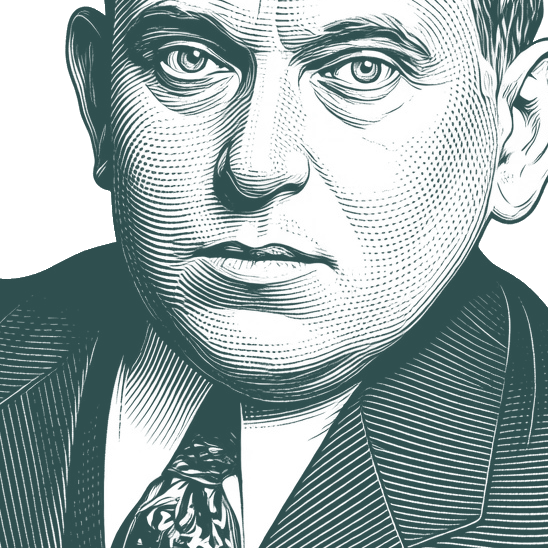
Poverty is a soft pedal upon the branches of human activity, not excepting the spiritual. - H. L. Mencken
""
Poverty is a soft pedal upon the branches of human activity, not excepting the spiritual.
English
Collect this quote
About
H. L. Mencken
Henry Louis Mencken (12 September 1880 – 29 January 1956), known as H. L. Mencken, was a twentieth-century journalist, satirist, social critic, cynic, and freethinker, known as the "Sage of Baltimore" and the "American Nietzsche". He is often regarded as one of the most influential American writers of the early 20th century.
Portrait adapted from
Wikimedia Commons, Ben Pinchot (Public domain / CC0)
The bitter, of course, goes with the sweet. To be an American is, unquestionably, to be the noblest, grandest, the proudest mammal that ever hoofed the verdure of God's green footstool. Often, in the black abysm of the night, the thought that I am one awakens me with a blast of trumpets, and I am thrown into a cold sweat by contemplation of the fact. I shall cherish it on the scaffold; it will console me in Hell. But there is no perfection under Heaven, so even an American has his small blemishes, his scarcely discernible weaknesses, his minute traces of vice and depravity.
By what route do otherwise sane men come to believe such palpable nonsense? How is it possible for a human brain to be divided into two insulated halves, one functioning normally, naturally and even brilliantly, and the other capable only of such ghastly balderdash which issues from the minds of Baptist evangelists? Such balderdash takes various forms, but it is at its worst when it is religious. Why should this be so? What is there in religion that completely flabbergasts the wits of those who believe in it? I see no logical necessity for that flabbergasting. Religion, after all, is nothing but an hypothesis framed to account for what is evidentially unaccounted for. In other fields such hypotheses are common, and yet they do no apparent damage to those who incline to them. But in the religious field they quickly rush the believer to the intellectual Bad Lands. He not only becomes anaesthetic to objective fact; he becomes a violent enemy of objective fact. It annoys and irritates him. He sweeps it away as something somehow evil. . .
The most costly of all follies is to believe passionately in the palpably not true. It is the chief occupation of mankind.