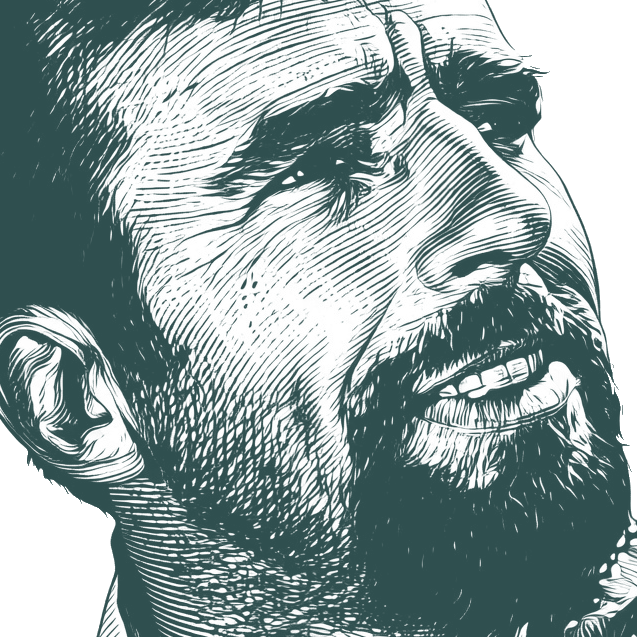
I believe that the military-industrial state will eventually collapse, possibly even in our lifetime, and that a majority of us (if prepared) will mu… - Edward Abbey
""
I believe that the military-industrial state will eventually collapse, possibly even in our lifetime, and that a majority of us (if prepared) will muddle through to a freer, more open, less crowded, green and spacious agrarian society. (Maybe; of course it may be only a repeat of the middle ages.)
Edward Paul Abbey (29 January 1927 – 14 March 1989) was an American writer noted for his advocacy of environmental issues and criticism of public land policies.
Biography information from
Wikiquote·
Portrait adapted from
Wikimedia Commons, Photo by Woody Hilbert (Public domain / CC0)
confusing the thing observed with the mind of the observer, of constructing not a picture of external reality but simply a mirror of the thinker. Can this danger be avoided without falling into an opposite but related error, that of separating too deeply the observer and the thing observed, subject and object, and again falsifying our view of the world? There is no way out of these difficulties — you might as well try running Cataract Canyon without hitting a rock. Best to launch forth boldly, with or without life jackets, keep your matches dry and pray for the best.
"People who think that love, sex, marriage, work, play, life and death are serious matters are urged NOT to read this book. Buy it, yes, but don't read it. [Regarding "The Fool's Progress"]"
Limited Time Offer
Premium members can get their quote collection automatically imported into their Quotewise collections.
Suppose we were planning to impose a dictatorial regime upon the American people — the following preparations would be essential: 1. Concentrate the populace in megalopolitan masses so that they can be kept under close surveillance and where, in case of trouble, they can be bombed, burned, gassed or machine-gunned with a minimum of expense and waste. 2. Mechanize agriculture to the highest degree of refinement, thus forcing most of the scattered farm and ranching population into the cities. Such a policy is desirable because farmers, woodsmen, cowboys, Indians, fishermen and other relatively self-sufficient types are difficult to manage unless displaced from their natural environment. 3. Restrict the possession of firearms to the police and the regular military organizations. 4. Encourage or at least fail to discourage population growth. Large masses of people are more easily manipulated and dominated than scattered individuals. 5. Continue military conscription. Nothing excels military training for creating in young men an attitude of prompt, cheerful obedience to officially constituted authority. 6. Divert attention from deep conflicts within the society by engaging in foreign wars; make support of these wars a test of loyalty, thereby exposing and isolating potential opposition to the new order. 7. Overlay the nation with a finely reticulated network of communications, airlines and interstate autobahns. 8. Raze the wilderness. Dam the rivers, flood the canyons, drain the swamps, log the forests, strip-mine the hills, bulldoze the mountains, irrigate the deserts and improve the national parks into national parking lots. Idle speculations, feeble and hopeless protest. It was all foreseen nearly half a century ago by the most cold-eyed and clear-eyed of our national poets, on California’s shore, at the end of the open road. Shine, perishing republic.