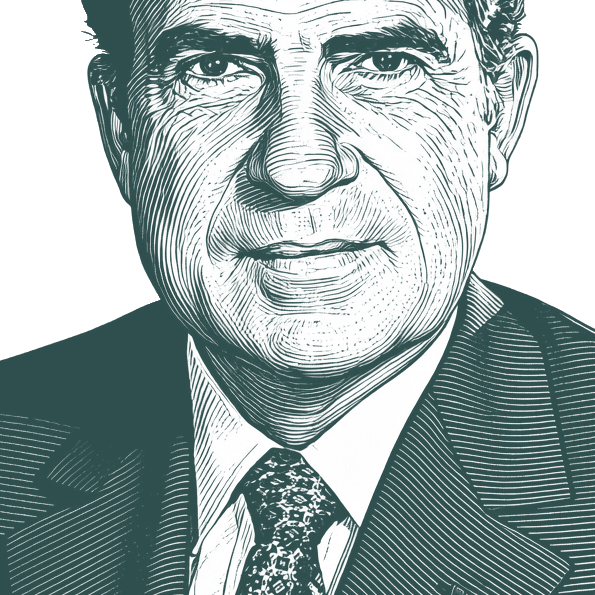
I don't give a shit what happens. I want you all to stonewall it, let them plead the Fifth Amendment, cover up or anything else, if it'll save it, sa… - Richard Nixon
""
I don't give a shit what happens. I want you all to stonewall it, let them plead the Fifth Amendment, cover up or anything else, if it'll save it, save this plan. That's the whole point. We're going to protect our people if we can.
English
Collect this quote
About
Richard Nixon
Richard Milhous Nixon (9 January 1913 – 22 April 1994) was the 37th president of the United States, serving from 1969 to 1974, when he became the only president to resign the office. Nixon had previously served as a Republican U.S. representative and senator from California from 1947 to 1952 and as the 36th vice president of the United States from 1953 to 1961.
Portrait adapted from
Wikimedia Commons, Department of Defense. Department of the Army. Office of the Deputy Chief of Staff for Operations. U.S. Army Audiovisual Center. (ca. 1974 - 05/15/1984) (Public domain / CC0)
Also Known As
Birth Name:
Richard Milhous Nixon
Also Known As:Dick Nixon
Alternative Names:
Nixon
•
President Nixon
•
R. Nixon
•
R. M. Nixon
•
Richard M. Nixon
•
Tricky Dick
•
President Richard Nixon
Portrait from Wikimedia Commons. Credit: Department of Defense. Department of the Army. Office of the Deputy Chief of Staff for Operations. U.S. Army Audiovisual Center. (ca. 1974 - 05/15/1984). Used under Public domain / CC0. Processed and styled by Quotewise.
Works in ChatGPT, Claude, or Any AI
Add semantic quote search to your AI assistant via MCP. One command setup.
I have two suggestions. One is to the number of cities. Going from 75 cities to 125 is ambitious. I think it could be more. In meeting with Don Kernal and also in meeting with members of the Chamber of Commerce a couple of days ago, I urged the possibility of considering a number of smaller towns or smaller cities for this particular group to operate in. I do not know whether that is feasible. But I do know that the spirit is there. I do know that the personnel are there, that the desire is there, and also the problem. While it would not appear that such massive strides could be made when we talk about smaller towns and smaller cities, certainly it is something that could be considered. Then, the second area, one that you have already made great progress in, is with regard to youth. I was particularly impressed by the fact that 120,000 young Americans found jobs last summer as a result of what the Alliance did. What I am proposing now is that even more emphasis be put on this youth program.
Well, you can just stop and think of what could happen if anybody with a decent system of government got control of that mainland. Good God. There'd be no power in the world that could even — I mean, you put 800 million Chinese to work under a decent system and they will be the leaders of the world
PREMIUM FEATURE
Advanced Search Filters
Filter search results by source, date, and more with our premium search tools.
Some critics call ours an "immoral" society because they disagree with its policies, or they refuse to obey its laws because they claim that those laws have no moral basis. Yet the structure of our laws has rested from the beginning on a foundation of moral purpose. That moral purpose embodies what is, above all, a deeply humane set of values--rooted in a profound respect for the individual, for the integrity of his person, for the dignity of his humanity. At first glance, there is something homely and unexciting about basic values as we have long believed in them. And we feel apologetic about espousing them; even the profoundest truths become cliches with repetition. But these truths can be like sleeping giants: slow to rouse, but magnificent in their strength. So today let us look at some of those values--so familiar now, and yet once so revolutionary in America and in the world: liberty, recognizing that liberties can only exist in balance, with the liberty of each stopping at that point at which it would infringe the liberty of another; freedom of conscience, meaning that each person has the freedom of his own conscience, and therefore none has the right to dictate the conscience of his neighbor; justice, recognizing that true justice is impartial and that no man can be judge in his own cause; human dignity, a dignity that inspires pride, is rooted in self-reliance, and provides the satisfaction of being a useful and respected member of the community; concern, concern for the disadvantaged and dispossessed, but a concern that neither panders nor patronizes; the right to participate in public decisions, which carries with it the duty to abide by those decisions when reached, recognizing that no one can have his own way all the time; human fulfillment, in the sense not of unlimited license, but of maximum opportunity; the right to grow, to reach upward, to be all that we can become, in a system that rewards enterprise, encourages innovation, and honors excellence.