I believe you will be shocked by my stating this so bluntly because we are still guided instinctively by those inherited "natural" emotions. But I th… - Friedrich Hayek
""
I believe you will be shocked by my stating this so bluntly because we are still guided instinctively by those inherited "natural" emotions. But I think we must recognize that we have become a worldwide, peaceful, and prosperous society by having learned to disregard those natural instincts and to follow instead certain abstract rules of honesty—rules establishing private property and ultimately codified in the form of private law. It is the rules of property and contract on which the growth of a worldwide, peaceful, and prosperous society was based. All these are traditional rules that evolved by a process of selection, which made those groups who followed the new rules more prosperous than other groups, and which thus came gradually to govern the civilised part of the world. Those communities who adopted the new rules and, in doing so, infringed upon deeply embedded natural feelings became the successful ones, the ones who multiplied because they were more prosperous and were able to attract people from other groups.
English
Collect this quote
About
Friedrich Hayek
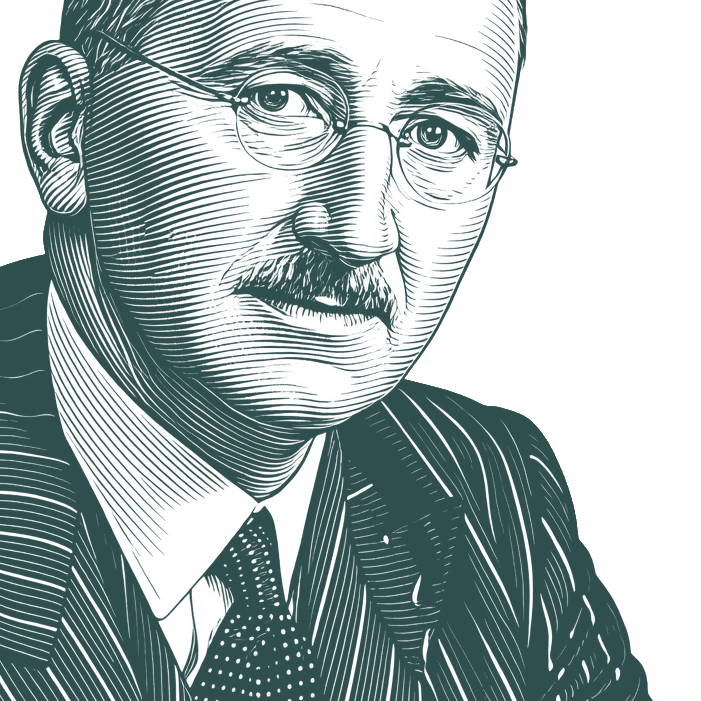
Friedrich August von Hayek CH (8 May 1899 – 23 March 1992) was an Austrian, later British, economist and philosopher best known for his defense of classical liberalism. In 1974, Hayek shared the (with Gunnar Myrdal) for his "pioneering work in the theory of money and economic fluctuations and … penetrating analysis of the interdependence of economic, social and institutional phenomena". (Nobel Memorial Prize, 1974)
Portrait adapted from
Wikimedia Commons, The original uploader was DickClarkMises at English Wikipedia. (CC BY-SA)
Also Known As
Native Name:
Friedrich August von Hayek
Alternative Names:
Friedrich von Hayek
•
Friedrich A. von Hayek
•
Friedrich A. Von Hayek
•
F. A. von Hayek
•
Friedrich August Von Hayek
•
Hayek
•
F. A. Hayek
The reasons why the adoption of a system of central planning necessarily produces a totalitarian system are fairly simple. Whoever controls the means must decide which ends they are to serve. As under modern conditions control of economic activity means control of the material means for practically all our ends, it means control over nearly all our activities. The nature of the detailed scale of values which must guide the planning makes it impossible that it should be determined by anything like democratic means. The director of the planned system would have to impose his scale of values, his hierarchy of ends, which, if it is to be sufficient to determine the plan, must include a definite order of rank in which the status of each person is laid down. If the plan is to succeed or the planner to appear successful, the people must be made to believe that the objectives chosen are the right ones. Every criticism of the plan or the ideology underlying it must be treated as sabotage. There can be no freedom of thought, no freedom of the Press, where it is necessary that everything should be governed by a single system of thought. In theory Socialism may wish to enhance freedom, but in practice every kind of collectivism consistently carried thought must produce the characteristic features which Fascism, Nazism, and Communism have in common. Totalitarianism is nothing but consistent collectivism, the ruthless execution of the principle that 'the whole comes before the individual' and the direction of all members of society by a single will supposed to represent the 'whole'.
The next time I met Ludwig Wittgenstein was in the spring of 1928 when the economist Dennis Robertson, who was taking me for a walk through the Fellows' Gardens of Trinity College, Cambridge, suddenly decided to change course because on the top of a little rise he perceived the form of the philosopher draped over a deckchair. He evidently stood rather in awe of him, and he did not wish to disturb him.
If a big country like the United States did return to the gold standard, it would start a great deflation. Most likely the government couldn't stick to it for long. They'd switch the policy to some halfway measure like a gold exchange standard.