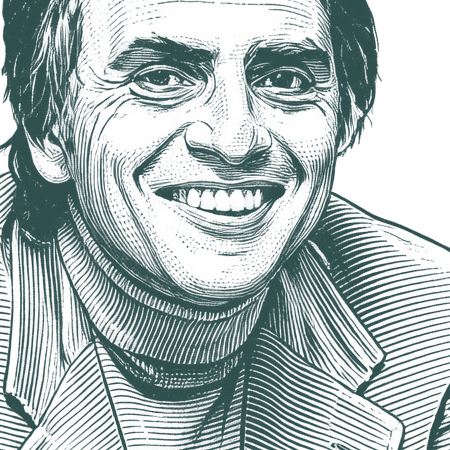
Carl Edward Sagan (9 November 1934 – 20 December 1996) was an American astronomer, planetary scientist, cosmologist, astrophysicist, astrobiologist, author, and science communicator. His best known scientific contribution is research on extraterrestrial life, including experimental demonstration of the production of amino acids from basic chemicals by radiation. Sagan assembled the first physical messages sent into space, the Pioneer plaque and the Voyager Golden Record, universal messages that could potentially be understood by any extraterrestrial intelligence that might find them. Sagan argued the hypothesis, accepted since, that the high surface temperatures of Venus can be attributed to, and calculated using, the greenhouse effect. He testified to the US Congress in 1985 that the greenhouse effect will change the earth's climate system.
Biography information from
Wikiquote·
Portrait adapted from
Wikimedia Commons, NASA/JPL (Public domain / CC0)
Also Known As
Native Name:
Carl Edward Sagan
Alternative Names:
Sagan
•
Carl E. Sagan
•
Carl E Sagan
•
C. E. Sagan
•
C.E. Sagan
•
C E Sagan
•
C. Sagan
•
C Sagan
•
Sagan C
•
Sagan C.
•
Sagan C. E.
•
Sagan CE
If we can accomplish the integration of the search without obliterating cultural differences or destroying ourselves, we will have accomplished a great thing.
Indeed, much of Newton’s intellectual development can be attributed to this tension between rationalism and mysticism. At the Stourbridge Fair in 1663, at age twenty, he purchased a book on astrology, ‘out of a curiosity to see what there was in it.’ He read it until he came to an illustration which he could not understand, because he was ignorant of trigonometry. So he purchased a book on trigonometry but soon found himself unable to follow the geometrical arguments. So he found a copy of Euclid’s Elements of Geometry, and began to read. Two years later he invented the differential calculus.
Go Premium
Support Quotewise while enjoying an ad-free experience and premium features.
The reappearance of the crescent moon after the new moon; the return of the Sun after a total eclipse, the rising of the Sun in the morning after its troublesome absence at night were noted by people around the world; these phenomena spoke to our ancestors of the possibility of surviving death. Up there in the skies was also a metaphor of immortality.