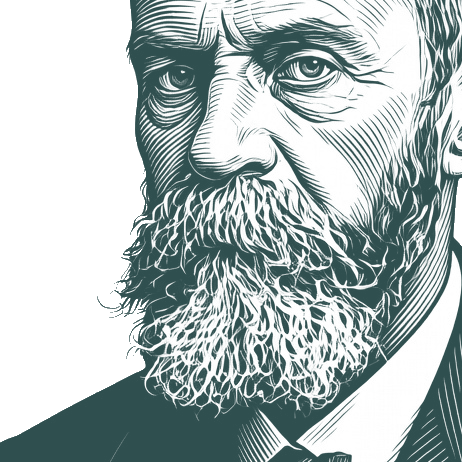
Good-humor is a philosophic state of mind; it seems to say to Nature that we take her no more seriously than she takes us. I maintain that one should… - William James
""
Good-humor is a philosophic state of mind; it seems to say to Nature that we take her no more seriously than she takes us. I maintain that one should always talk of philosophy with a smile.
William James (11 January 1842 – 26 August 1910) was a pioneering American psychologist and philosopher. He developed the philosophical perspective known as radical empiricism, and wrote influential books on the science of psychology, the psychology of religious experience and mysticism, and the philosophy of pragmatism.
Biography information from
Wikiquote·
Portrait adapted from
Wikimedia Commons, Alice Boughton (Public domain / CC0)
In its widest possible sense, however, a man's Self is the sum total of all that he can call his, not only his body and his psychic powers, but his clothes and his house, his wife and children, his ancestors and friends, his reputation and works, his lands and horses, and yacht and bank-account. All these things give him the same emotions. If they wax and prosper, he feels triumphant; if they dwindle and die away, he feels cast down.
"Theologians have by this time stretched their minds so as to embrace the darwinian facts, and yet to interpret them as still showing divine purpose. It used to be a question of purpose AGAINST mechanism, of one OR the other. It was as if one should say "My shoes are evidently designed to fit my feet, hence it is impossible that they should have been produced by machinery.
Enhance Your Quote Experience
Enjoy ad-free browsing, unlimited collections, and advanced search features with Premium.
This world might be a world in which all things differed, and in which what properties there were were ultimate and had no farther predicates. In such a world there would be as many kinds as there were separate things. We could never subsume a new thing under an old kind; or if we could, no consequences would follow. Or, again, this might be a world in which innumerable things were of a kind, but in which no concrete thing remained of the same kind long, but all objects were in a flux. Here again, though we could subsume and infer, our logic would be of no practical use to us, for the subjects of our propositions would have changed whilst we were talking. In such worlds logical relations would obtain, and be known (doubtless) as they are now, but they would form a merely theoretic scheme and be of no use for the conduct of life. But our world is no such world. It is a very peculiar world, and plays right into logic's hands. Some of the things, at least, which it contains are of the same kind as other things; some of them remain always of the kind of which they once were; and some of the properties of them cohere indissolubly and are always found together. Which things these latter things are we learn by experience in the strict sense of the word, and the results of the experience are embodied in 'empirical propositions.' Whenever such a thing is met with by us now, our sagacity notes it to be of a certain kind; our learning immediately recalls that kind's kind, and then that kind's kind, and so on; so that a moment's thinking may make us aware that the thing is of a kind so remote that we could never have directly perceived the connection. The flight to this last kind over the heads of the intermediaries is the essential feature of the intellectual operation here. Evidently it is a pure outcome of our sense for apprehending serial increase; and, unlike the several propositions themselves which make up the series (and which may all be empirical), it has nothing to do with the time- and space-order in which the things have been experienced.