When it is stated in Genesis that God said to Adam, “Only from the tree of the knowledge of good and evil you must not eat,” it follows as a matter o… - Søren Kierkegaard
""
When it is stated in Genesis that God said to Adam, “Only from the tree of the knowledge of good and evil you must not eat,” it follows as a matter of course that Adam really has not understood this word, for how could he understand the difference between good and evil when this distinction would follow as a consequence of the enjoyment of the fruit. When it is assumed that the prohibition awakens the desire one acquires knowledge instead of ignorance, and in that case Adam must have had knowledge of freedom, because the desire was to use it. The explanation is therefore subsequent. The prohibition induces in him anxiety, for the prohibition awakens in him freedom’s possibility. What passed by innocence as the nothing of anxiety has now entered into Adam, and here again it is a nothing-the anxious possibility of being able. He has no conception of what he is able to do; otherwise-and this it what usually happens-that which comes later, the difference between good and evil, would have to be presupposed. Only the possibility of being able is present as a higher form of ignorance, as a higher expression of anxiety, because in a higher sense it both is and is not, because in a higher sense he both loves it and flees from it.
English
Collect this quote
About
Søren Kierkegaard
Søren Aabye Kierkegaard (5 May 1813 – 11 November 1855) was a Danish Christian philosopher and theologian, considered to be a founder of Existentialist thought and Absurdist traditions. He wrote critical texts on organized religion, Christendom, morality, ethics, psychology and philosophy of religion, displaying a fondness for metaphor, irony and parables.
Biography information from
Wikiquote·
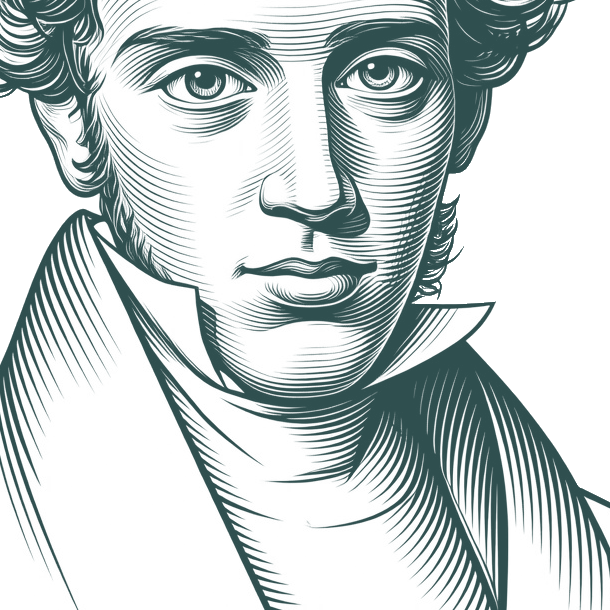
Portrait adapted from
Wikimedia Commons, La Biblioteca Real de Dinamarca (Public domain / CC0)
Also Known As
Pen Names:
Victor Eremita
•
A
•
Judge William
•
Johannes de silentio
•
Constantine Constantius
•
Young Man
•
Vigilius Haufniensis
•
Nicolaus Notabene
•
Hilarius Bookbinder
•
Johannes Climacus
•
Inter et Inter
•
H.H.
•
Anti-Climacus
•
B
•
Johannes de Silentio
•
Constantin Constantius
•
P. CH. Kierkegaard
Native Name:
Søren Aabye Kierkegaard
Alternative Names:
Kierkegaard
•
Climacus
•
Sören Aaby Kierkegaard
One must not think slightingly of the paradoxical…for the paradox is the source of the thinker’s passion, and the thinker without a paradox is like a lover without feeling: a paltry mediocrity.
She was a riddle, who mysteriously possessed her own solution, a secret, and what are all diplomats' secrets compared with this, an enigma, and what in all the world is so beautiful as the word that solves it?
Unlimited Quote Collections
Organize your favorite quotes without limits. Create themed collections for every occasion with Premium.
If Hegel had written the whole of his logic and then said, in the preface or some other place, that it was merely an experiment in thought in which he had even begged the question in many places, then he would certainly have been the greatest thinker who had ever lived. As it is, he is merely comic.