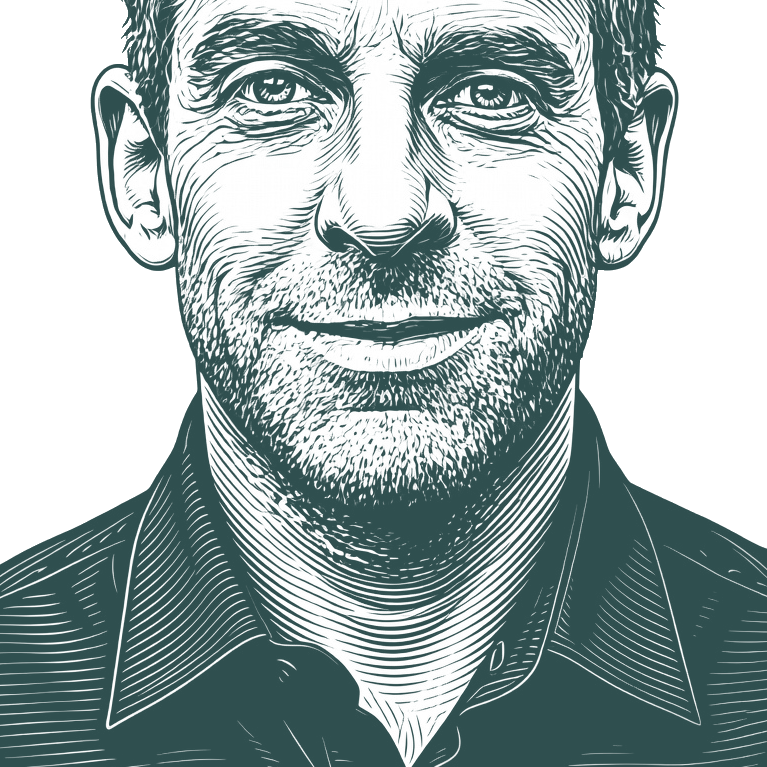
I never made more effort than I did when practicing under U Pandita. But most of this effort arose from the very illusion of bondage to the self that… - Sam Harris

" "

I never made more effort than I did when practicing under U Pandita. But most of this effort arose from the very illusion of bondage to the self that I was seeking to overcome. The model of this practice is that one must climb the mountain so that freedom can be found at the top. But the self is already an illusion, and that truth can be glimpsed directly, at the mountain's base or anywhere else along the path. One can then return to this insight, again and again, as one's sole method of meditation—thereby arriving at the goal in each moment of actual practice.

English
Collect this quote

About Sam Harris

Samuel Benjamin Harris (born April 9, 1967) is an American author, philosopher, public intellectual, and neuroscientist, as well as the co-founder and CEO of Project Reason. He is the author of The End of Faith (2004), which won the PEN/Martha Albrand Award for First Nonfiction in 2005 and appeared on The New York Times best seller list for 33 weeks, Letter to a Christian Nation (2006), The Moral Landscape (2010), Lying (2011), Free Will (2012), and most recently Waking Up: A Guide to Spirituality Without Religion (2014).

Biography information from Wikiquote

Also Known As

Birth Name: Samuel Benjamin Harris
Alternative Names: Samuel Harris
Works in ChatGPT, Claude, or Any AI

Add semantic quote search to your AI assistant via MCP. One command setup.

Related quotes. More quotes will automatically load as you scroll down, or you can use the load more buttons.

Shorter versions of this quote

Additional quotes by Sam Harris

Let’s say your life has gone off track. You used to be very motivated, inspired by your opportunities, and physically fit, but now you are lazy, easily discouraged, and overweight. How did you get this way? You might be able to tell a story about how your life unraveled, but you cannot truly account for why you let it happen.

Our past is not sacred for being past, and there is much that is behind us that we are struggling to keep behind us, and to which, it is to be hoped, we could never return with a clear conscience: the divine right of kings, feudalism, the caste system, slavery, political executions, forced castration, vivisection, bearbaiting, honorable duels, chastity belts, trial by ordeal, child labor, human and animal sacrifice, the stoning of heretics, cannibalism, sodomy laws, taboos against contraception, human radiation experiments - the lists is nearly endless, and if it were extended indefinitely, the proportion of abuses for which religion could be found directly responsible is likely to remain undiminished. In fact, almost every indignity just mentioned can be attributed to an insufficient taste for evidence, to an uncritical faith in one dogma or another.

PREMIUM FEATURE
Advanced Search Filters

Filter search results by source, date, and more with our premium search tools.

In the fall of 2006, I participated in a three-day conference at the Salk Institute entitled Beyond Belief: Science, Religion, Reason, and Survival. This event was organized by Roger Bingham and conducted as a town-hall meeting before an audience of invited guests. Speakers included Steven Weinberg, Harold Kroto, Richard Dawkins, and many other scientists and philosophers who have been, and remain, energetic opponents of religious dogmatism and superstition. It was a room full of highly intelligent, scientifically literate people — molecular biologists, anthropologists, physicists, and engineers — and yet, to my amazement, three days were insufficient to force agreement on the simple question of whether there is any conflict at all between religion and science. Imagine a meeting of mountaineers unable to agree about whether their sport ever entails walking uphill, and you will get a sense of how bizarre our deliberations began to seem.
While at Salk, I witnessed scientists giving voice to some of the most dishonest religious apologies I have ever heard. It is one thing to be told that the pope is a peerless champion of reason and that his opposition to embryonic stem-cell research is both morally principled and completely uncontaminated by religious dogmatism; it is quite another to be told this by a Stanford physician who sits on the President’s Council on Bioethics. Over the course of the conference, I had the pleasure of hearing that Hitler, Stalin, and Mao were examples of secular reason run amok, that the Islamic doctrines of martyrdom and jihad are not the cause of Islamic terrorism, that people can never be argued out of their beliefs because we live in an irrational world, that science has made no important contributions to our ethical lives (and cannot), and that it is not the job of scientists to undermine ancient mythologies and, thereby, “take away people’s hope” — all from atheist scientists who, while insisting on their own skeptical hardheadedness, we

Loading...