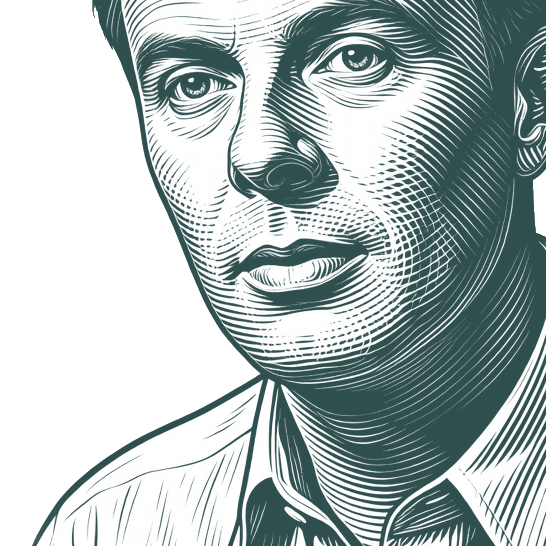
It's curious," he went on after a little pause, "to read what people in the time of Our Ford used to write about scientific progress. They seemed to … - Aldous Huxley
""
It's curious," he went on after a little pause, "to read what people in the time of Our Ford used to write about scientific progress. They seemed to have imagined that it could be allowed to go on indefinitely, regardless of everything else. Knowledge was the highest good, truth the supreme value; all the rest was secondary and subordinate. True, ideas were beginning to change even then. Our Ford himself did a great deal to shift the emphasis from truth and beauty to comfort and happiness. Mass production demanded the shift. Universal happiness keeps the wheels steadily turning; truth and beauty can't.
English
Collect this quote
About
Aldous Huxley
Aldous Leonard Huxley (26 July 1894 – 22 November 1963) was a British author known for his novel Brave New World. He was the grandson of Thomas Henry Huxley and younger brother of Julian Huxley.
We can never dispense with language and the other symbol systems; for it is by means of them, and only by their means, that we have raised ourselves above the brutes, to the level of human beings. But we can easily become the victims as well as the beneficiaries of these systems. We must learn how to handle words effectively; but at the same time we must preserve and, if necessary, intensify our ability to look at the world directly and not through that half opaque medium of concepts, which distorts every given fact into the all too familiar likeness of some generic label or explanatory abstraction.
The legs, for example, of that chair — how miraculous their tubularity, how supernatural their polished smoothness! I spent several minutes — or was it several centuries? — not merely gazing at those bamboo legs, but actually being them — -or rather being myself in them; or, to be still more accurate (for "I" was not involved in the case, nor in a certain sense were "they") being my Not-self in the Not-self which was the chair.
There is only one corner of the universe you can be certain of improving, and that is your own self. So you have to begin there, not outside, not on other people. That comes afterwards, when you have worked on your own corner.