The love of a dog for his master is notorious; in the agony of death he has been known to caress his master, and every one has heard of the dog suffe… - Charles Darwin
""
The love of a dog for his master is notorious; in the agony of death he has been known to caress his master, and every one has heard of the dog suffering under vivisection, who licked the hand of the operator; this man, unless he had a heart of stone, must have felt remorse to the last hour of his life.
English
Collect this quote
About
Charles Darwin
Charles Robert Darwin (12 February 1809 – 19 April 1882) was an English naturalist, geologist and biologist, best known for his contributions to the science of evolution. He proposed that evolution could be explained in part through natural and sexual selection. Prompted by awareness that Alfred Russel Wallace was developing similar theories he published his own sooner than he had originally intended. This theory is now an integral component of biological science.
Biography information from
Wikiquote·
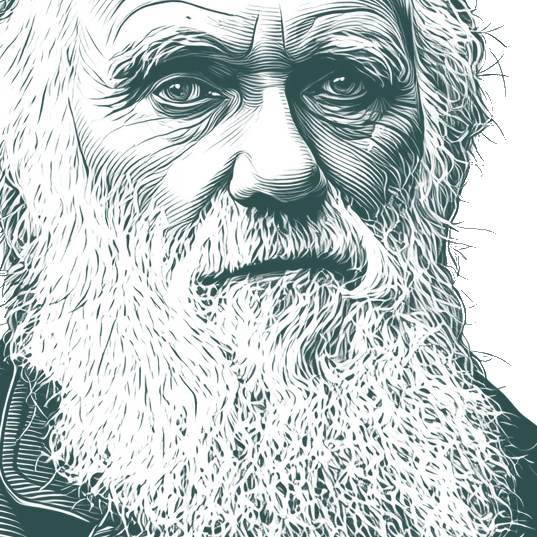
Portrait adapted from
Wikimedia Commons, Herbert Rose Barraud (Public domain / CC0)
Also Known As
Birth Name:
Charles Robert Darwin
Alternative Names:
Charles R. Darwin
•
C. R. Darwin
•
Darwin
•
C.R. Darwin
•
CR Darwin
How fleeting are the wishes and efforts of man! How short his time! Consequently how poor will his products be, compared with those accumulated by nature during whole geological periods. Can we wonder, then, that nature’s productions should be far “truer” in character than man’s productions; that they should be infinitely better adapted to the most complex conditions of life, and should plainly bear the stamp of far higher workmanship?
The loss of these tastes [for poetry and music] is a loss of happiness, and may possibly be injurious to the intellect, and more probably to the moral character, by enfeebling the emotional part of our nature.
Try QuoteGPT
Chat naturally about what you need. Each answer links back to real quotes with citations.
Vox populi, vox Dei is Latin for "The voice of the people is the voice of God". "Sarcode" is an archaic term for protoplasm.