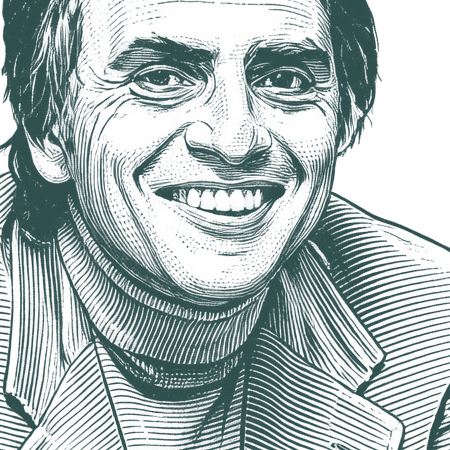
We live in an extraordinary age. These are times of stunning changes in social organization, economic well-being, moral and ethical precepts, philoso… - Carl Sagan
""
We live in an extraordinary age. These are times of stunning changes in social organization, economic well-being, moral and ethical precepts, philosophical and religious perspectives, and human self-knowledge, as well as in our understanding of that vast universe in which we are imbedded like a grain of sand in a cosmic ocean. As long as there have been human beings, we have posed the deep and fundamental questions, which evoke wonder and stir us into at least a tentative and trembling awareness, questions on the origins of consciousness; life on our planet; the beginnings of the Earth; the formation of the Sun; the possibility of intelligent beings somewhere up there in the depths of the sky; as well as, the grandest inquiry of all - on the advent, nature and ultimate destiny of the universe. For all but the last instant of human history these issues have been the exclusive province of philosophers and poets, shamans and theologians. The diverse and mutually contradictory answers offered demonstrate that few of the proposed solutions have been correct. But today, as a result of knowledge painfully extracted from nature, through generations of careful thinking, observing, and experimenting, we are on the verge of glimpsing at least preliminary answers to many of these questions.
...If we do not destroy ourselves, most of us will be around for the answers. Had we been born fifty years earlier, we could have wondered, pondered, speculated about these issues, but we could have done nothing about them. Had we been born fifty years later, the answers would, I think, already have been in. Our children will have been taught the answers before most of them will have had the opportunity to even formulate the questions. By far the most exciting, satisfying and exhilarating time to be alive is the time in which we pass from ignorance to knowledge on these fundamental issues; the age where we begin in wonder and end in understanding. In all of the four-billion-year history of
Carl Edward Sagan (9 November 1934 – 20 December 1996) was an American astronomer, planetary scientist, cosmologist, astrophysicist, astrobiologist, author, and science communicator. His best known scientific contribution is research on extraterrestrial life, including experimental demonstration of the production of amino acids from basic chemicals by radiation. Sagan assembled the first physical messages sent into space, the Pioneer plaque and the Voyager Golden Record, universal messages that could potentially be understood by any extraterrestrial intelligence that might find them. Sagan argued the hypothesis, accepted since, that the high surface temperatures of Venus can be attributed to, and calculated using, the greenhouse effect. He testified to the US Congress in 1985 that the greenhouse effect will change the earth's climate system.
Biography information from
Wikiquote·
Portrait adapted from
Wikimedia Commons, NASA/JPL (Public domain / CC0)
Also Known As
Native Name:
Carl Edward Sagan
Alternative Names:
Sagan
•
Carl E. Sagan
•
Carl E Sagan
•
C. E. Sagan
•
C.E. Sagan
•
C E Sagan
•
C. Sagan
•
C Sagan
•
Sagan C
•
Sagan C.
•
Sagan C. E.
•
Sagan CE
If prayer works, why can’t God cure cancer or grow back a severed limb? Why so much avoidable suffering that God could so readily prevent? Why does God have to be prayed to at all? Doesn’t He already know what cures need to be performed? Dossey also begins with a quote from Stanley Krippner, M.D. (described as “one of the most authoritative investigators of the variety of unorthodox healing methods used around the world”): [T]he research data on distant, prayer-based healing are promising, but too sparse to allow any firm conclusion to be drawn. This after many trillions of prayers over the millennia.
Our planet is a lonely speck in the great enveloping cosmic dark. In our obscurity, in all this vastness, there is no hint that help will come from elsewhere to save us from ourselves.
Enhance Your Quote Experience
Enjoy ad-free browsing, unlimited collections, and advanced search features with Premium.
Science is more than a body of knowledge; it is a way of thinking. I have a foreboding of an America in my children’s or grandchildren’s time — when the United States is a service and information economy; when nearly all the key manufacturing industries have slipped away to other countries; when awesome technological powers are in the hands of a very few, and no one representing the public interest can even grasp the issues; when the people have lost the ability to set their own agendas or knowledgeably question those in authority; when, clutching our crystals and nervously consulting our horoscopes, our critical faculties in decline, unable to distinguish between what feels good and what’s true, we slide, almost without noticing, back into superstition and darkness.
The dumbing down of America is most evident in the slow decay of substantive content in the enormously influential media, the 30-second sound bites (now down to 10 seconds or less), lowest common denominator programming, credulous presentations on pseudoscience and superstition, but especially a kind of celebration of ignorance.