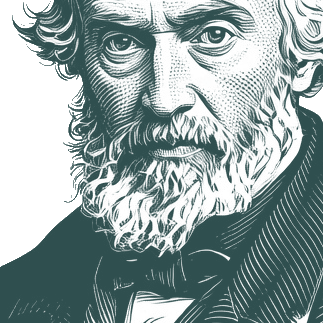
There is no act more moral between men than that of rule and obedience. Woe to him that claims obedience when it is not due; woe to him that refuses … - Thomas Carlyle
""
There is no act more moral between men than that of rule and obedience. Woe to him that claims obedience when it is not due; woe to him that refuses it when it is! God's law is in that, I say, however the Parchment-laws may run: there is a Divine Right or else a Diabolic Wrong at the heart of every claim that one man makes upon another.
English
Collect this quote
About
Thomas Carlyle
Thomas Carlyle (December 4 1795 – February 5 1881) was a Scottish essayist, historian and philosopher of great prominence during the Victorian era. His wife was Jane Welsh Carlyle.
Biography information from
Wikiquote·
Portrait adapted from
Wikimedia Commons, Sir John Everett Millais, 1st Bt (died 1896) (Public domain / CC0)
Portrait from Wikimedia Commons. Credit: Sir John Everett Millais, 1st Bt (died 1896). Used under Public domain / CC0. Processed and styled by Quotewise.
Enhance Your Quote Experience
Enjoy ad-free browsing, unlimited collections, and advanced search features with Premium.
What is Democracy; this huge inevitable Product of the Destinies, which is everywhere the portion of our Europe in these latter days? There lies the question for us. Whence comes it, this universal big black Democracy; whither tends it; what is the meaning of it? A meaning it must have, or it would not be here. If we can find the right meaning of it, we may, wisely submitting or wisely resisting and controlling, still hope to live in the midst of it; if we cannot find the right meaning, if we find only the wrong or no meaning in it, to live will not be possible! — The whole social wisdom of the Present Time is summoned, in the name of the Giver of Wisdom, to make clear to itself, and lay deeply to heart with an eye to strenuous valiant practice and effort, what the meaning of this universal revolt of the European Populations, which calls itself Democracy, and decides to continue permanent, may be.
Wondrous indeed is the virtue of a true Book.
[T]he most remarkable piece of reading that you may be recommended to take and try if you can study is a book by Goethe—one of his last books, which he wrote when he was an old man, about seventy years of age—I think one of the most beautiful he ever wrote, full of mild wisdom, and which is found to be very touching by those who have eyes to discern and hearts to feel it. It is one of the pieces in "Wilhelm Meister's Travels." I read it through many years ago; and, of course, I had to read into it very hard when I was translating it (applause), and it has always dwelt in my mind as about the most remarkable bit of writing that I have known to be executed in these late centuries. I have often said, there are ten pages of that which, if ambition had been my only rule, I would rather have written than have written all the books that have appeared since I came into the world.