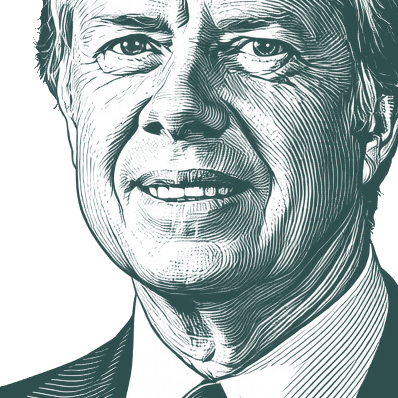
I was on duty when our submarine went into port in Nassau and tied up at the Prince George Wharf, and I was the officer who accepted an invitation fr… - Jimmy Carter
""
I was on duty when our submarine went into port in Nassau and tied up at the Prince George Wharf, and I was the officer who accepted an invitation from the governor-general of the Bahamas for our officers and crewmen to attend an official ball to honor the U.S. Navy. There was a more private comment that a number of young ladies would be present with their chaperones. All of us were pleased and excited, and Captain Andrews responded affirmatively. We received a notice the next day that, of course, the nonwhite crewmen would not be included. When I brought this message to the captain, he had the crew assemble in the mess hall and asked for their guidance in drafting a response. After multiple expletives were censored from the message, we unanimously declined to participate. The decision by the crew of the K-1 was an indication of how equal racial treatment had been accepted — and relished. I was very proud of my ship. On leave
English
Collect this quote
About
Jimmy Carter
James Earl Carter, Jr. (October 1, 1924 – December 29, 2024) was an American politician and member of the Democratic Party who served as the 39th president of the United States from 1977 to 1981. In 1982 he established the Carter Center, as a base for promoting human rights, democracy, finding peaceful solutions to international conflicts, and advancing economic and social development, for which he was awarded the Nobel Peace Prize in 2002. He was a key figure in the Habitat for Humanity project, and has been noted for his criticism of Israel's role in the Israeli–Palestinian conflict.
Biography information from
Wikiquote·
Portrait adapted from
Wikimedia Commons, Department of Defense. Department of the Navy. Naval Photographic Center (Public domain / CC0)
Also Known As
Birth Name:
James Earl Carter Jr.
Alternative Names:
James E. Carter
•
James Carter
•
James Earl Carter
•
39th President of the United States
•
James E. Carter Jr.
•
James Earl Carter, Jr.
•
James E. Carter, Jr.
We should live our lives as though Christ was coming this afternoon.
National weakness — real or perceived — can tempt aggression and thus cause war. That's why the United States cannot neglect its military strength. We must and we will remain strong. But with equal determination, the United States and all countries must find ways to control and reduce the horrifying danger that is posed by the world's enormous stockpiles of nuclear arms. This has been a concern of every American president since the moment we first saw what these weapons could do. Our leaders will require our understanding and our support as they grapple with this difficult but crucial challenge. There is no disagreement on the goals or the basic approach to controlling this enormous destructive force. The answer lies not just in the attitudes or actions of world leaders, but in the concern and demands of all of us as we continue our struggle to preserve the peace.
Unlimited Quote Collections
Organize your favorite quotes without limits. Create themed collections for every occasion with Premium.
I've not had a chance to watch the television programs, except that my staff puts together an 18- or 20-minute recap on some of the highlights. And I see those on occasion. I spent all yesterday and today in my regular business and meeting with Prime Minister Barre. But my assessment from the brief time I've watched it, and also from my own staff, is that he has enhanced his position, because he was in a situation where, literally, for weeks, all kinds of allegations or charges were made, including criminal violation of the writing of checks to avoid paying of taxes, which is fraudulent and illegal. He was alleged to be an embezzler by a convicted felon. And on that basis, the chairman and the minority leader of the Senate [committee] had called for his immediate resignation, and he had not had a chance to answer those charges. Now that he has answered the charges--I hope and believe successfully--I think he's certainly enhanced his position.