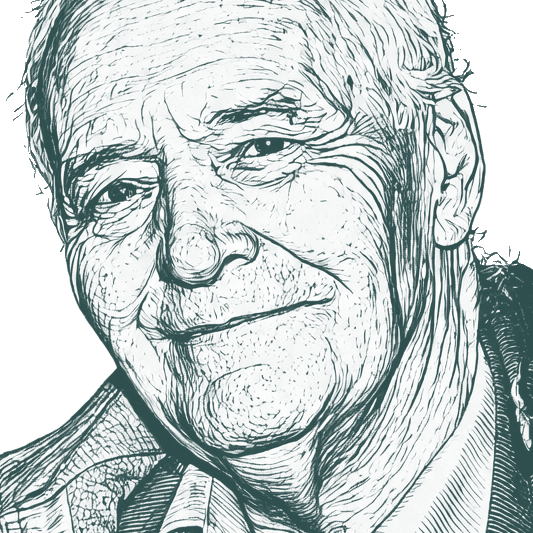
I don't think people realise how the establishment became established. They simply stole land and property from the poor, surrounded themselves with … - Tony Benn
""
I don't think people realise how the establishment became established. They simply stole land and property from the poor, surrounded themselves with weak minded sycophants for protection, gave themselves titles and have been wielding power ever since.
Disputed attribution. This quote's attribution is contested.
Anthony Neil Wedgwood Benn (3 April 1925 – 14 March 2014), known between 1960 and 1963 as Viscount Stansgate, was a British Labour Party politician and diarist who served as a Cabinet minister in the 1960s and 1970s. He was the Member of Parliament for Bristol South East and Chesterfield for 47 of the 51 years between 1950 and 2001. He later served as President of the Stop the War Coalition from 2001 to 2014.
Had a long talk to the Chinese First Secretary at the embassy — a very charming man called Liao Dong — and said how much I admired Mao Tse tung or Zedong, the greatest man of the twentieth century. He said that I couldn't admire Mao more than he did. I asked him how Mao was viewed now. He said Mao was 70 per cent right and 30 per cent wrong; the Cultural Revolution didn't work. He said he had been named after Mao — it was amusing.
[T]he Party must have a much wider appeal. We have thought of the Party a bit narrowly, in terms of economic and industrial policy, as if every problem could be solved by setting up a quango. We have got to think of the appeal to women, to blacks, to the wider peace movement, the ecological movement and the regions. We have got to think out the whole devolution argument... You and I come from old-fashioned radical liberal families, and libertarianism is what it is about.
I must tell the House quite frankly that if I were confronted with a Japanese at this present moment and were asked to tell him that I believed that he was wrong in the treatment of those British prisoners in his hands, I could not but accept a similar criticism from him on the question of the atom bomb. I should be quite unable to avoid it. I am afraid I must say on the question of principle here involved—this question of moral principle—that I believe it to be humbug, when so many people, women, children, old folk, were killed by the atom bombs at Nagasaki and Hiroshima. For every individual photograph that could be produced of a wounded and battered British prisoner of war in Japanese hands, I think one could find an equally horrible photograph of a victim of the atomic bomb. [Interruption.] An hon. Friend of mine says that the two things are not comparable. I do not myself believe that it is possible to draw any distinctions in war between the brutalities on both sides.