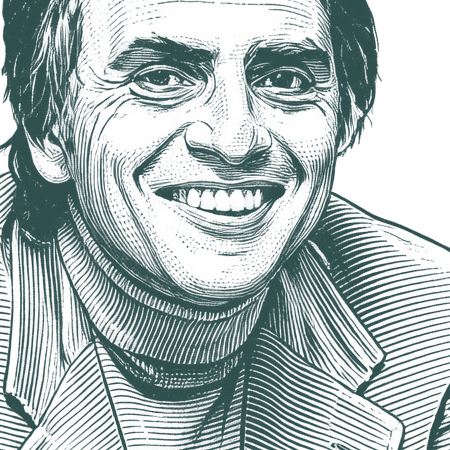
"Frequentemente me perguntam: "Você acredita que existe inteligência exraterrestre?" Respondo com os argumentos padrões - há muitos lugares no espaço… - Carl Sagan
"Frequentemente me perguntam: "Você acredita que existe inteligência exraterrestre?" Respondo com os argumentos padrões - há muitos lugares no espaço, as moléculas da vida estão por toda parte, emprego a palavra bilhões, e assim por diante. Depois digo que ficaria espantado senão houvesse inteligência extraterrestre, mas que ainda não há absolutamente nenhuma evidência convincente de que ela existe. Muitas vezes me perguntam a seguir: -O que você realmente acha? Respondo: -Acabei de lhe dizer o que realmente acho. -Sim, mas qual é a sua opinião visceral? Mas eu tento não pensar com as minhas vísceras. Se levo a sério minha tentativa de compreender o mundo, pensar com algum órgão que não seja o cérebro, por mais tentador que possa ser, provavelmente complicará a minha vida. Na verdade, é correto guardar a opinião para quando houver evidências."
Carl Edward Sagan (9 November 1934 – 20 December 1996) was an American astronomer, planetary scientist, cosmologist, astrophysicist, astrobiologist, author, and science communicator. His best known scientific contribution is research on extraterrestrial life, including experimental demonstration of the production of amino acids from basic chemicals by radiation. Sagan assembled the first physical messages sent into space, the Pioneer plaque and the Voyager Golden Record, universal messages that could potentially be understood by any extraterrestrial intelligence that might find them. Sagan argued the hypothesis, accepted since, that the high surface temperatures of Venus can be attributed to, and calculated using, the greenhouse effect. He testified to the US Congress in 1985 that the greenhouse effect will change the earth's climate system.
Biography information from
Wikiquote·
Portrait adapted from
Wikimedia Commons, NASA/JPL (Public domain / CC0)
Also Known As
Native Name:
Carl Edward Sagan
Alternative Names:
Sagan
•
Carl E. Sagan
•
Carl E Sagan
•
C. E. Sagan
•
C.E. Sagan
•
C E Sagan
•
C. Sagan
•
C Sagan
•
Sagan C
•
Sagan C.
•
Sagan C. E.
•
Sagan CE
Why is the half of humanity with a special sensitivity to the preciousness of life, the half untainted by testosterone poisoning, almost wholly unrepresented in defense establishments and peace negotiations worldwide? [blurb on Daniella Gioseffi's _Women on War_; quoted in Carol Lynn Pearson's _The Ghost of Eternal Polygamy_]
They remind us that humans have evolved to wonder, that understanding is a joy, that knowledge is prerequisite to survival. I believe our future depends on how well we know this Cosmos in which we float like a mote of dust in the morning sky.
As science advances, there seems to be less and less for God to do. It's a big universe, of course, so He, She, or It, could be profitably employed in many places. But what has clearly been happening is that evolving before our eyes has been a God of the Gaps; that is, whatever it is we cannot explain lately is attributed to God. And then after a while, we explain it, and so that's no longer God's realm.