To our ancestors there was much in Nature to be afraid of — lightning, storms, earthquakes, volcanos, plagues, drought, long winters. Religions arose… - Carl Sagan
""
To our ancestors there was much in Nature to be afraid of — lightning, storms, earthquakes, volcanos, plagues, drought, long winters. Religions arose in part as attempts to propitiate and control, if not much to understand, the disorderly aspect of Nature. The scientific revolution permitted us to glimpse an underlying ordered Universe in which there was a literal harmony of the worlds (Johannes Kepler’s phrase). If we understand Nature, there is a prospect of controlling it or at least mitigating the harm it may bring. In this sense, science brought hope.
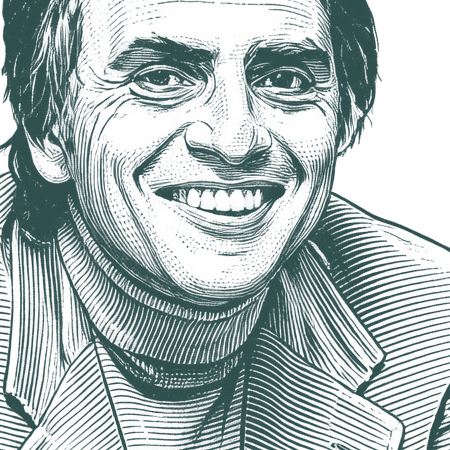
Carl Edward Sagan (9 November 1934 – 20 December 1996) was an American astronomer, planetary scientist, cosmologist, astrophysicist, astrobiologist, author, and science communicator. His best known scientific contribution is research on extraterrestrial life, including experimental demonstration of the production of amino acids from basic chemicals by radiation. Sagan assembled the first physical messages sent into space, the Pioneer plaque and the Voyager Golden Record, universal messages that could potentially be understood by any extraterrestrial intelligence that might find them. Sagan argued the hypothesis, accepted since, that the high surface temperatures of Venus can be attributed to, and calculated using, the greenhouse effect. He testified to the US Congress in 1985 that the greenhouse effect will change the earth's climate system.
Biography information from
Wikiquote·
Portrait adapted from
Wikimedia Commons, NASA/JPL (Public domain / CC0)
Also Known As
Native Name:
Carl Edward Sagan
Alternative Names:
Sagan
•
Carl E. Sagan
•
Carl E Sagan
•
C. E. Sagan
•
C.E. Sagan
•
C E Sagan
•
C. Sagan
•
C Sagan
•
Sagan C
•
Sagan C.
•
Sagan C. E.
•
Sagan CE
In a world in transition, students and teachers both need to teach themselves one essential skill - learning how to learn.
If I were to propose to you that my arm could be in this position or in that position but it would be forbidden by the laws of nature to be in some intermediate position, that would likely strike you as absurd, as contrary to experience. And yet on the subatomic level, there is a quantization of energy and position and momentum. The reason that it seems counterintuitive is that is that we are not ordinarily down at the level of the very small, where quantum effects dominate.
El tamaño y la edad del Cosmos superan la comprensión normal del hombre. Nuestro diminuto hogar planetario está perdido en algún punto entre la inmensidad y la eternidad. En una perspectiva cósmica la mayoría de las preocupaciones humanas parecen insignificantes, incluso frívolas. Sin embargo nuestra especie es joven, curiosa y valiente, y promete mucho. En los últimos milenios hemos hecho los descubrimientos más asombrosos e inesperados sobre el Cosmos y el lugar que ocupamos en él; seguir el hilo de estas exploraciones es realmente estimulante. Nos recuerdan que los hombres han evolucionado para admirarse de las cosas, que comprender es una alegría, que el conocimiento es requisito esencial para la supervivencia. Creo que nuestro futuro depende del grado de comprensión que tengamos del Cosmos en el cual flotamos como una mota de polvo en el cielo de la mañana.