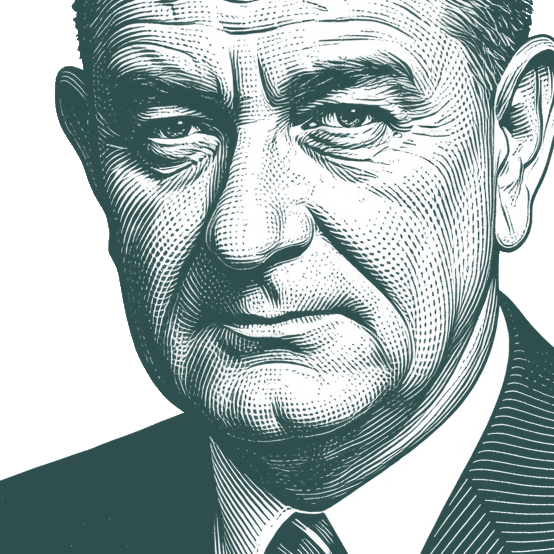
We have carried our quest for peace to many nations and peoples because we share this planet with others whose future, in large measure, is tied to o… - Lyndon B. Johnson
""
We have carried our quest for peace to many nations and peoples because we share this planet with others whose future, in large measure, is tied to our own action, and whose counsel is necessary to our own hopes. We have found understanding and support. And we know they wait with us tonight for some response that could lead to peace. I wish tonight that I could give you a blueprint for the course of this conflict over the coming months, but we just cannot know what the future may require. We may have to face long, hard combat or a long, hard conference, or even both at once. Until peace comes, or if it does not come, our course is clear. We will act as we must to help protect the independence of the valiant people of South Vietnam. We will strive to limit the conflict, for we wish neither increased destruction nor do we want to invite increased danger. But we will give our fighting men what they must have: every gun, and every dollar, and every decision—whatever the cost or whatever the challenge. And we will continue to help the people of South Vietnam care for those that are ravaged by battle, create progress in the villages, and carry forward the healing hopes of peace as best they can amidst the uncertain terrors of war. And let me be absolutely clear: The days may become months, and the months may become years, but we will stay as long as aggression commands us to battle. There may be some who do not want peace, whose ambitions stretch so far that war in Vietnam is but a welcome and convenient episode in an immense design to subdue history to their will. But for others it must now be clear—the choice is not between peace and victory, it lies between peace and the ravages of a conflict from which they can only lose.
Lyndon Baines Johnson (27 August 1908 – 22 January 1973), often referred to by his initials LBJ, was an American politician. After a long career in U.S. legislatures, Johnson became the vice president of the United States of America under John F. Kennedy, from 1961 to 1963. A Democrat, Johnson became the 36th U.S. president in 1963, after Kennedy's assassination. He served in the role until 1969.
Portrait adapted from
Wikimedia Commons, Arnold Newman (Public domain / CC0)
Also Known As
Native Name:
Lyndon Baines Johnson
Also Known As:LBJ
Alternative Names:
Lyndon Johnson
•
President Johnson
•
L. B. Johnson
These last 50 years have been decades of decision. In our conscience and in our laws, we have decided that children belong in classrooms and not in sweatshops and coal mines. We have decided that young women should work in surroundings of decency and not in sweatshops of degradation; that the sick and the suffering, the blind and the deaf, the mentally ill and the mentally retarded should have our care--and not our curses. Yes, in these 50 years we have set for America a direction toward human decency and human dignity. We have held our country on a course of compassion. The course we have set over those years--the course that you really helped to set--is the course of today's America. We are going to keep America moving. We are going to move forward with the American people.
We will serve all the Nation, not one section or one sector, or one group, but all Americans. These are the United States-a united people with a united purpose. Our American unity does not depend upon unanimity. We have differences; but now, as in the past, we can derive from those differences strength, not weakness, wisdom, not despair. Both as a people and a government, we can unite upon a program, a program which is wise and just, enlightened and constructive.
Works in ChatGPT, Claude, or Any AI
Add semantic quote search to your AI assistant via MCP. One command setup.
But these are the problems which America faces. They are problems which can only be solved by an informed citizenship. This requirement calls all of us to give them attention. This recurrent sounding of the call to battle is one of the most valuable contributions that can be made by the labor press in the United States.