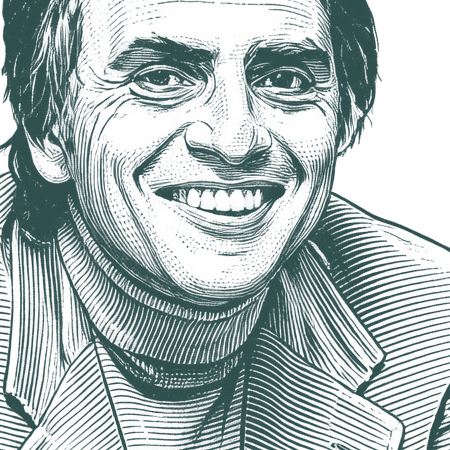
If you’re young, it’s just possible that we will be taking our first steps on near-Earth asteroids and Mars during your lifetime. To spread out to th… - Carl Sagan
""
If you’re young, it’s just possible that we will be taking our first steps on near-Earth asteroids and Mars during your lifetime. To spread out to the moons of the Jovian planets and the Kuiper Comet Belt will take many generations more. The Oort Cloud will require much longer still. By the time we’re ready to settle even the nearest other planetary systems, we will have changed. The simple passage of so many generations will have changed us. The different circumstances we will be living under will have changed us. Prostheses and genetic engineering will have changed us. Necessity will have changed us. We’re an adaptable species. It will not be we who reach Alpha Centauri and the other nearby stars. It will be a species very like us, but with more of our strengths and fewer of our weaknesses, a species returned to circumstances more like those for which it was originally evolved, more confident, farseeing, capable, and prudent — the sorts of beings we would want to represent us in a Universe that, for all we know, is filled with species much older, much more powerful, and very different. The vast distances that separate the stars are providential. Beings and worlds are quarantined from one another. The quarantine is lifted only for those with sufficient self-knowledge and judgment to have safely traveled from star to star.
Carl Edward Sagan (9 November 1934 – 20 December 1996) was an American astronomer, planetary scientist, cosmologist, astrophysicist, astrobiologist, author, and science communicator. His best known scientific contribution is research on extraterrestrial life, including experimental demonstration of the production of amino acids from basic chemicals by radiation. Sagan assembled the first physical messages sent into space, the Pioneer plaque and the Voyager Golden Record, universal messages that could potentially be understood by any extraterrestrial intelligence that might find them. Sagan argued the hypothesis, accepted since, that the high surface temperatures of Venus can be attributed to, and calculated using, the greenhouse effect. He testified to the US Congress in 1985 that the greenhouse effect will change the earth's climate system.
Biography information from
Wikiquote·
Portrait adapted from
Wikimedia Commons, NASA/JPL (Public domain / CC0)
Also Known As
Native Name:
Carl Edward Sagan
Alternative Names:
Sagan
•
Carl E. Sagan
•
Carl E Sagan
•
C. E. Sagan
•
C.E. Sagan
•
C E Sagan
•
C. Sagan
•
C Sagan
•
Sagan C
•
Sagan C.
•
Sagan C. E.
•
Sagan CE
I proffer the following ideas with a substantial degree of trepidation; I know very well that many of them are speculative and can be proved or disproved on the anvil of experiment.
Absence of Evidence does not mean Evidence of Absence
Go Premium
Support Quotewise while enjoying an ad-free experience and premium features.
And reading itself is an amazing activity: You glance at a thin, flat object made from a tree...and the voice of the author begins to speak inside your head. (Hello!)