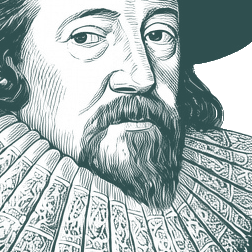
Atheism leaves a man to sense, to philosophy, to natural piety, to laws, to reputation; all which may be guides to an outward moral virtue, though re… - Francis Bacon
""
Atheism leaves a man to sense, to philosophy, to natural piety, to laws, to reputation; all which may be guides to an outward moral virtue, though religion were not; but superstition dismounts all these, and erecteth an absolute monarchy in the minds of men. Therefore atheism did never perturb states; for it makes men wary of themselves, as looking no further: and we see the times inclined to atheism (as the time of Augustus Cæsar) were civil times. But superstition hath been the confusion of many states, and bringeth in a new primum mobile, that ravisheth all the spheres of government. The master of superstition is the people; and in all superstition wise men follow fools; and arguments are fitted to practice, in a reversed order.
Francis Bacon, 1st Viscount St. Alban KC (22 January 1561 – 9 April 1626) was an English philosopher, statesman and essayist. His works argued for the possibility of scientific knowledge based only upon inductive reasoning and careful observation of events in nature. Most importantly, he argued this could be achieved by use of a sceptical and methodical approach whereby scientists aim to avoid misleading themselves. His general idea of the importance and possibility of a skeptical methodology makes Bacon the father of the scientific method. This marked a new turn in the rhetorical and theoretical framework for science, the practical details of which are still central in debates about science and methodology today.
Biography information from
Wikiquote·
Portrait adapted from
Wikimedia Commons, Paul van Somer I / Formerly attributed to Frans Pourbus the Younger (Public domain / CC0)
Also Known As
Alternative Names:
Franciscus Bacon
•
Francis Bacon of Verulamius
•
Francis Bacon, Lord Verulam
•
Bacon, Francis, 1561-1626
•
Francis Bacon, Viscount Saint Alban
Related quotes. More quotes will automatically load as you scroll down, or you can use the load more buttons.
Shorter versions of this quote
Atheism leads a man to sense, to philosophy, to natural piety, to laws, to reputation: all of which may be guides to an outward moral virtue.
Atheism leaves a man to sense, to philosophy, to natural piety, to laws, to reputation; all of which may be guides to an outward moral virtue, even if religion vanished; but religious superstition dismounts all these and erects an absolute monarchy in the minds of men.
PREMIUM FEATURE
Advanced Search Filters
Filter search results by source, date, and more with our premium search tools.
Atheism leads a man to sense, to philosophy, to natural piety, to laws, to reputation: all of which may be guides to an outward moral virtue. (c. 1625)
There are and can be only two ways of searching into and discovering truth. The one flies from the senses and particulars to the most general axioms, and from these principles, the truth of which it takes for settled and immovable, proceeds to judgment and to the discovery of middle axioms. And this way is now in fashion. The other derives axioms from the senses and particulars, rising by a gradual and unbroken ascent, so that it arrives at the most general axioms last of all. This is the true way, but as yet untried.
The beginning is from God: for the business which is in hand, having the character of good so strongly impressed upon it, appears manifestly to proceed from God, who is the author of good, and the Father of Lights. Now in divine operations even the smallest beginnings lead of a certainty to their end. And as it was said of spiritual things, "The kingdom of God cometh not with observation," so is it in all the greater works of Divine Providence; everything glides on smoothly and noiselessly, and the work is fairly going on "before men are aware that it has begun. Nor should the prophecy of Daniel be forgotten, touching the last ages of the world: —"Many shall go to and fro, and knowledge shall be increased;" clearly intimating that the thorough passage of the world (which now by so many distant voyages seems to be accomplished, or in course of accomplishment), and the advancement of the sciences, are destined by fate, that is, by Divine Providence, to meet in the same age.
Go Premium
Support Quotewise while enjoying an ad-free experience and premium features.