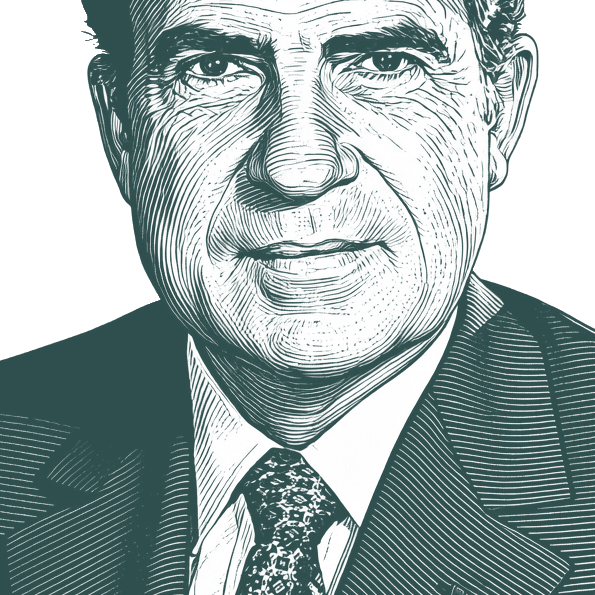
This I pledge to you tonight: The nation that went to the moon in peace for all mankind is ready, ready to share its technology in peace with its nea… - Richard Nixon
""
This I pledge to you tonight: The nation that went to the moon in peace for all mankind is ready, ready to share its technology in peace with its nearest neighbors. Tonight, I have discussed with you a new concept of partnership. I have made a commitment to act. I have been trying to give some examples of actions we are prepared to take. But as anyone familiar with government knows, commitment alone is not enough. There has to be the machinery to assure an effective follow-through. Therefore, I am also directing a major reorganization and upgrading of the United States Government structure for dealing with Western Hemisphere affairs. As a key element of this--and this is one of those areas where the President cannot do it, he needs the approval of the Congress--but as a key element of this, I have ordered preparation of a legislative request, which I will submit to the Congress, raising the rank of the Assistant Secretary of State for Inter-American Affairs to Under Secretary--thus giving the hemisphere special representation. I know that many in this room, 15 years ago urged that upon me, and I see Mr. Pedro Beltran here particularly applauding. He urged it upon me just a few years ago, too. I trust that we will be able, through the new Under Secretary of State, to do a more effective job with regard to the problems of the hemisphere, and the new Under Secretary will be given authority to coordinate all United States Government activities in the hemisphere, so that there will be one window for all those activities.
English
Collect this quote
About
Richard Nixon
Richard Milhous Nixon (9 January 1913 – 22 April 1994) was the 37th president of the United States, serving from 1969 to 1974, when he became the only president to resign the office. Nixon had previously served as a Republican U.S. representative and senator from California from 1947 to 1952 and as the 36th vice president of the United States from 1953 to 1961.
Portrait adapted from
Wikimedia Commons, Department of Defense. Department of the Army. Office of the Deputy Chief of Staff for Operations. U.S. Army Audiovisual Center. (ca. 1974 - 05/15/1984) (Public domain / CC0)
Also Known As
Birth Name:
Richard Milhous Nixon
Also Known As:Dick Nixon
Alternative Names:
Nixon
•
President Nixon
•
R. Nixon
•
R. M. Nixon
•
Richard M. Nixon
•
Tricky Dick
•
President Richard Nixon
In other amendments, we are proposing significant changes in social services for the poor. This proposal has been developed in recent months and will be ready for submission to the Congress next week. These amendments will: Encourage accountability and program results; Strengthen the role of Governors, mayors, and county executives; Seek to eliminate duplication and overlap.
Try QuoteGPT
Chat naturally about what you need. Each answer links back to real quotes with citations.
Often the worst mischief is done in the name of the best cause. In our zeal for instant reform we should be careful not to destroy our educational standards and our educational system along with it, and not to undermine the process of freedom on which all else rests. The process of freedom will be less threatened in America, however, if we pay more heed to one of the great cries of our young people today. I speak now of their demand for honesty: intellectual honesty, personal honesty, public honesty. Much of what seems to be revolt is really little more than this: an attempt to strip away sham and pretense, to puncture illusion, to get down to the basic nub of truth. We should welcome this. We have seen too many patterns of deception in our lives: in political life, impossible promises; in advertising, extravagant claims; in business, shady deals. In personal life, we all have witnessed deceits that ranged from the "little white lie" to moral hypocrisy; from cheating on income taxes to bilking the insurance company. In public life, we have seen reputations destroyed by smear, and gimmicks paraded as panaceas. We have heard shrill voices of hate shouting lies and sly voices of malice twisting facts. Even in intellectual life, we too often have seen logical gymnastics performed to justify a pet theory, and refusal to accept facts that fail to support it. Of course, absolute honesty, on the other hand, would be ungenerous. Courtesy sometimes compels us to welcome the unwanted visitor, and kindness leads us to compliment the homely girl on how pretty she looks. But in our public discussions we sorely need a kind of honesty that too often has been lacking: the honesty of straight talk, a careful concern with the gradations of truth, a frank recognition of the limits of our knowledge about the problems we have to deal with. We have long demanded financial integrity in private life. We now need the most rigorous kind of intellectual integrity in public debate. Unless we can find a way to speak plainly and truly, unself-consciously, about the facts of public life, we may find that our grip on the forces of history is too loose to control our own destiny. The honesty of straight talk leads us to the conclusion that some of our recent social experiments have worked and some have failed and that most have achieved something--but far less than their advance billing promised. This same honesty is concerned not with assigning blame, but with discovering what lessons can be drawn from that experience in order to design better programs next time. Perhaps the goals were unattainable; perhaps the means were inadequate; perhaps the program was based on an unrealistic assessment of human nature. We can learn these lessons only to the extent that we can be candid with one another. We have and we face enormously complex choices. In approaching these, confrontation is no substitute for consultation; and passionate concern gets us nowhere without dispassionate analysis. More fundamentally, our structure of values depends on mutual faith, and faith depends on truth. The values we cherish are sustained by a fabric of mutual self-restraint woven of ordinary civil decency, respect for the rights of others, respect for the laws of the community, and respect for the democratic process of orderly change. The purpose of these restraints, I submit, is not to protect an "establishment," but to establish the protection of liberty; not to prevent change, but to insure that change reflects the public will and respects the rights of all. This process is our most precious resource as a nation, and it depends on public acceptance, public understanding, and public faith.