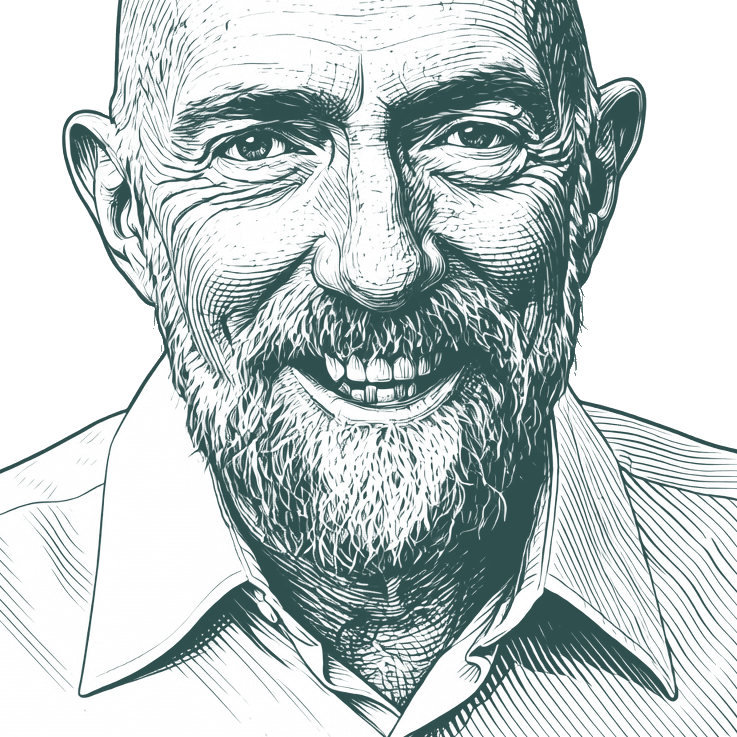
Kip Stephen Thorne (born June 1, 1940) is an American physicist at the California Institute of Technology who specializes in the cosmological implications of the general theory of relativity.
Some segments of this book may be rough going. That's the nature of real science. It requires thought. Sometimes deep thought. But thinking can be rewarding. You can just skip the rough parts, or you can struggle to understand.
Matthew Choptuik, a postdoctoral student at the University of Texas, carried out a simulation on a supercomputer that he hoped would reveal new, unexpected features of the laws of physics; and he hit the jackpot. What he simulated was the implosion of a gravitational wave.47 When the imploding wave was weak, it imploded and then disbursed. When it was strong, the wave imploded and formed a black hole. When its strength was very precisely “tuned” to an intermediate strength, the wave created a sort of boiling in the shapes of space and time. The boiling produced outgoing gravitational waves with shorter and shorter wavelengths. It also left behind, at the end, an infinitesimally tiny naked singularity (Figure 26.7). Fig. 26.6. Our bet about naked singularities. Fig. 26.7. Left: Matthew Choptuik. Middle: An imploding gravitational wave. Right: The boiling produced by the wave, and the naked singularity at the center of the magnifying glass. Now, such a singularity can never occur in nature. The required tuning is not a natural thing. But an exceedingly advanced civilization could produce such a singularity artificially by precisely tuning a wave’s implosion, and then could try to extract the laws of quantum gravity from the singularity’s behavior.
Works in ChatGPT, Claude, or Any AI
Add semantic quote search to your AI assistant via MCP. One command setup.