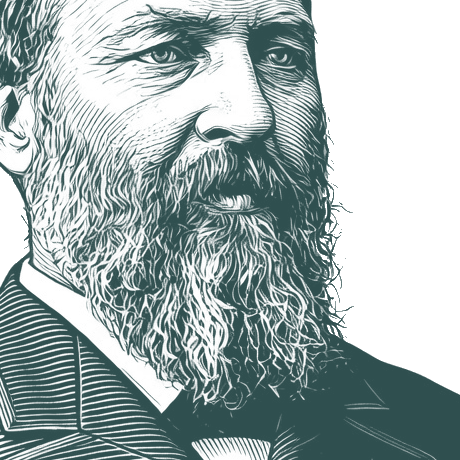
James Abram Garfield (19 November 1831 – 19 September 1881) was the 20th president of the United States of America in 1881, and the second U.S. president to be assassinated. His term was the second shortest in U.S. history, after William Henry Harrison's. Holding office from March to September of 1881, President Garfield was in office for a total of just six months and fifteen days. A Republican, he supported civil rights and freedoms for African Americans.
Biography information from
Wikiquote·
Portrait adapted from
Wikimedia Commons, Unknown; part of Brady-Handy Photograph Collection. (Public domain / CC0)
Also Known As
Birth Name:
James Abram Garfield
Alternative Names:
James Garfield
•
J. A. Garfield
•
J. Garfield
•
President Garfield
Portrait from Wikimedia Commons. Credit: Unknown; part of Brady-Handy Photograph Collection.. Used under Public domain / CC0. Processed and styled by Quotewise.
Try QuoteGPT
Chat naturally about what you need. Each answer links back to real quotes with citations.
Related quotes. More quotes will automatically load as you scroll down, or you can use the load more buttons.
The President is the last person in the world to know what the people really want and think.
After nearly a quarter of a century of prosperity under the Constitution, the spirit of slavery so far triumphed over the early principles and practices of the government that, in 1812, South Carolina and her followers in Congress succeeded in inserting the word 'white' in the suffrage clause of the act establishing a territorial government for Missouri. One by one the Slave States, and many of the free States, gave way before the crusade of slavery against negro citizenship. In 1817, Connecticut caught the infection, and in her constitution she excluded the negro from the ballot-box. In every other New England State his ancient right of suffrage has remained and still remains undisturbed. Free negroes voted in Maryland till 1833; in North Carolina, till 1835; in Pennsylvania, till 1838. It was the boast of Cave Johnson of Tennessee that he owed his election to Congress in 1828 to the free negroes who worked in his mills. They were denied the suffrage in 1834, under the new constitution of Tennessee, by a vote of thirty-three to twenty-three. As new States were formed, their constitutions for the most part excluded the negro from citizenship. Then followed the shameful catalogue of black laws; expatriation and ostracism in every form, which have so deeply disgraced the record of legislation in many of the States.
It is a brave man... who dares to look the devil in the face and tell him he is a devil.