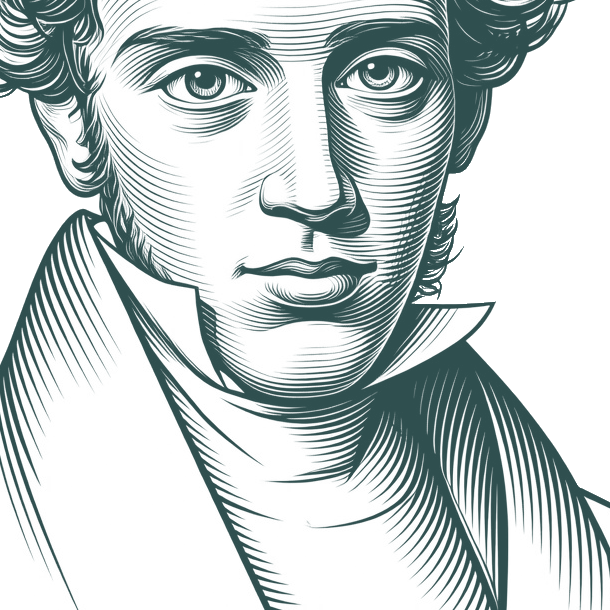
It is as useless for a person to want first of all to decide the externals and after that the fundamentals as it is for a cosmic body, thinking to fo… - Søren Kierkegaard
""
It is as useless for a person to want first of all to decide the externals and after that the fundamentals as it is for a cosmic body, thinking to form itself, first of all to decide the nature of its surface, to what bodies it should turn its light, which its dark side, without first letting the harmony of centrifugal and centripetal forces realize its existence and letting the rest come of itself. One must learn to know oneself before knowing anything else (gnothi seauton). Not until a person has inwardly understood himself and then sees the course he is to take does his life gain peace and meaning.
English
Collect this quote
About
Søren Kierkegaard
Søren Aabye Kierkegaard (5 May 1813 – 11 November 1855) was a Danish Christian philosopher and theologian, considered to be a founder of Existentialist thought and Absurdist traditions. He wrote critical texts on organized religion, Christendom, morality, ethics, psychology and philosophy of religion, displaying a fondness for metaphor, irony and parables.
Biography information from
Wikiquote·
Portrait adapted from
Wikimedia Commons, La Biblioteca Real de Dinamarca (Public domain / CC0)
Also Known As
Pen Names:
Victor Eremita
•
A
•
Judge William
•
Johannes de silentio
•
Constantine Constantius
•
Young Man
•
Vigilius Haufniensis
•
Nicolaus Notabene
•
Hilarius Bookbinder
•
Johannes Climacus
•
Inter et Inter
•
H.H.
•
Anti-Climacus
•
B
•
Johannes de Silentio
•
Constantin Constantius
•
P. CH. Kierkegaard
Native Name:
Søren Aabye Kierkegaard
Alternative Names:
Kierkegaard
•
Climacus
•
Sören Aaby Kierkegaard
If I had a humble spirit in my service who, when I asked for a glass of water, brought me the world's costliest wines blended in a chalice, I should dismiss him, in order to teach him that my pleasure consists, not in what I enjoy, but in having my own way.
It is impossible to exist without passion
PREMIUM FEATURE
Advanced Search Filters
Filter search results by source, date, and more with our premium search tools.
I think I have the courage to doubt everything; I think I have the courage to fight everything. But I do not have the courage to know anything, nor to possess, to own anything. Most people complain that the world is so prosaic, that life isn't like a romantic novel where opportunities are always so favourable. What I complain of is that life is not like a novel where there are hard-hearted fathers, and goblins and trolls to fight with, enchanted princesses to free. What are all such enemies taken together compared to the pallid, bloodless, glutinous nocturnal shapes with which I fight and to which I myself give life and being.