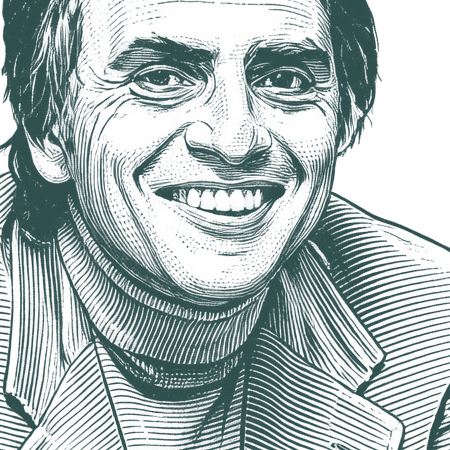
This will rise to ten million annual deaths by 2020 — in part because of a massive advertising campaign to portray smoking as advanced and fashionabl… - Carl Sagan
""
This will rise to ten million annual deaths by 2020 — in part because of a massive advertising campaign to portray smoking as advanced and fashionable to young women in the developing world.
English
Collect this quote
About
Carl Sagan
Carl Edward Sagan (9 November 1934 – 20 December 1996) was an American astronomer, planetary scientist, cosmologist, astrophysicist, astrobiologist, author, and science communicator. His best known scientific contribution is research on extraterrestrial life, including experimental demonstration of the production of amino acids from basic chemicals by radiation. Sagan assembled the first physical messages sent into space, the Pioneer plaque and the Voyager Golden Record, universal messages that could potentially be understood by any extraterrestrial intelligence that might find them. Sagan argued the hypothesis, accepted since, that the high surface temperatures of Venus can be attributed to, and calculated using, the greenhouse effect. He testified to the US Congress in 1985 that the greenhouse effect will change the earth's climate system.
Biography information from
Wikiquote·
Portrait adapted from
Wikimedia Commons, NASA/JPL (Public domain / CC0)
Also Known As
Native Name:
Carl Edward Sagan
Alternative Names:
Sagan
•
Carl E. Sagan
•
Carl E Sagan
•
C. E. Sagan
•
C.E. Sagan
•
C E Sagan
•
C. Sagan
•
C Sagan
•
Sagan C
•
Sagan C.
•
Sagan C. E.
•
Sagan CE
Pero los humanos tenemos talento para engañarnos a nosotros mismos. El escepticismo debe ser un componente de la caja de herramientas del explorador, en otro caso nos perderemos en el camino. El espacio tiene maravillas suficientes sin tener que inventarlas.
The Hindu religion is the only one of the world’s great faiths dedicated to the idea that the Cosmos itself undergoes an immense, indeed an infinite, number of deaths and rebirths. It is the only religion in which the time scales correspond to those of modern scientific cosmology. Its cycles run from our ordinary day and night to a day and night of Brahma, 8.64 billion years long. Longer than the age of the Earth or the Sun and about half the time since the Big Bang.
Try QuoteGPT
Chat naturally about what you need. Each answer links back to real quotes with citations.
"Both <a href="https://www.goodreads.com/author/show/201036.Barnum" rel="nofollow noopener" title="Barnum">Barnum</a> and <a href="https://www.goodreads.com/author/show/7805.H__L__Mencken" rel="nofollow noopener" title="H. L. Mencken">H. L. Mencken</a> are said to have made the depressing observation that no one ever lost money by underestimating the intelligence of the American public. The remark has worldwide application. But the lack is not in intelligence, which is in plentiful supply; rather, the scarce commodity is systematic training in critical thinking."