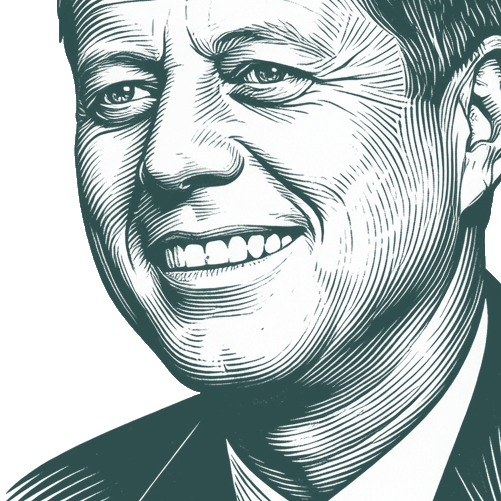
That is the kind of America in which I believe. And it represents the kind of Presidency in which I believe — a great office that must neither be hum… - John F. Kennedy
""
That is the kind of America in which I believe. And it represents the kind of Presidency in which I believe — a great office that must neither be humbled by making it the instrument of any one religious group nor tarnished by arbitrarily withholding its occupancy from the members of any one religious group. I believe in a President whose religious views are his own private affair, neither imposed by him upon the nation or imposed by the nation upon him as a condition to holding that office.
English
Collect this quote
About
John F. Kennedy
John Fitzgerald Kennedy (29 May 1917 – 22 November 1963), often referred to by his initials JFK and Jack, was the 35th president of the United States (1961–1963), a United States senator from Massachusetts (1953–1960), and a United States representative (1947–1953). Kennedy served at the height of the Cold War, and the majority of his work as president concerned relations with the Soviet Union and Cuba. He is the older brother of Robert F. Kennedy and Ted Kennedy, and the first husband of Jacqueline Kennedy Onassis. He was shot in the presence of his wife in Dallas on November 22, 1963.
Portrait adapted from
Wikimedia Commons, Cecil W. Stoughton (Public domain / CC0)
Also Known As
Birth Name:
John Fitzgerald Kennedy
Also Known As:Jack
Alternative Names:
Kennedy
•
Jack Kennedy
•
President Kennedy
•
J. F. Kennedy
•
JFK
•
John Kennedy
•
John Fitzgerald "Jack" Kennedy
•
JF Kennedy
•
John F Kennedy
Today we are committed to a worldwide struggle to promote and protect the rights of all who wish to be free. And when Americans are sent to Vietnam or West Berlin, we do not ask for whites only. It ought to be possible, therefore, for American students of any color to attend any public institution they select without having to be backed up by troops.
While we shall never weary in the defense of freedom, neither shall we ever abandon the pursuit of peace.
The artist, however faithful to his personal vision of reality, becomes the last champion of the individual mind and sensibility against an intrusive society and an officious state. The great artist is thus a solitary figure. He has, as Frost said, a lover's quarrel with the world. In pursuing his perceptions of reality, he must often sail against the currents of his time. This is not a popular role. If Robert Frost was much honored in his lifetime, it was because a good many preferred to ignore his darker truths. Yet in retrospect, we see how the artist's fidelity has strengthened the fiber of our national life. If sometimes our great artist have been the most critical of our society, it is because their sensitivity and their concern for justice, which must motivate any true artist, makes him aware that our Nation falls short of its highest potential. I see little of more importance to the future of our country and our civilization than full recognition of the place of the artist.